This Mitochondrial Membrane Potential Assay Kit (JC-1) is an assay kit for measuring Mitochondrial Membrane Potential (JC-1) in cells.
Applications
Functional Studies
Assay Type
Qualitative
Principle of Assay
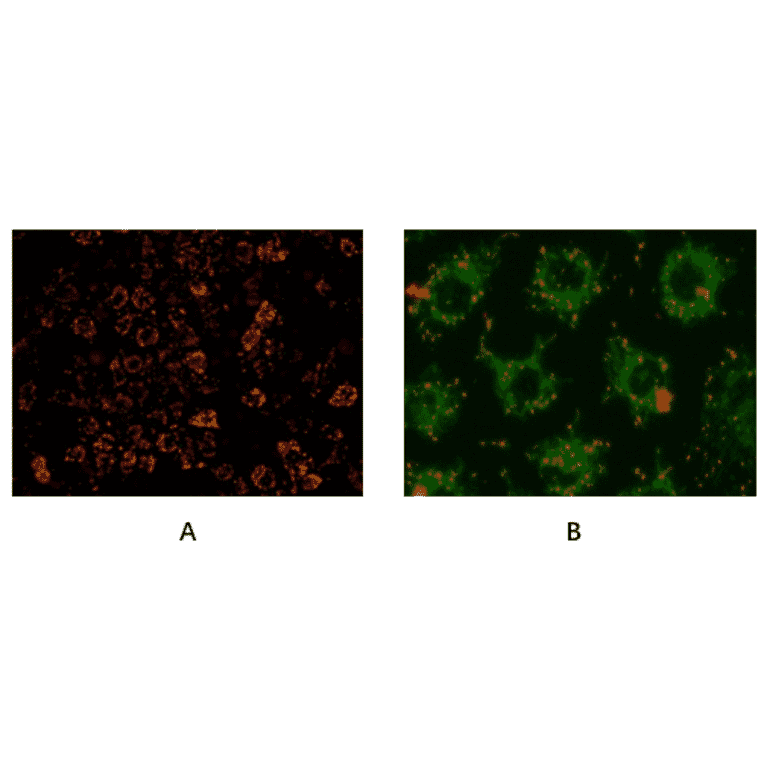
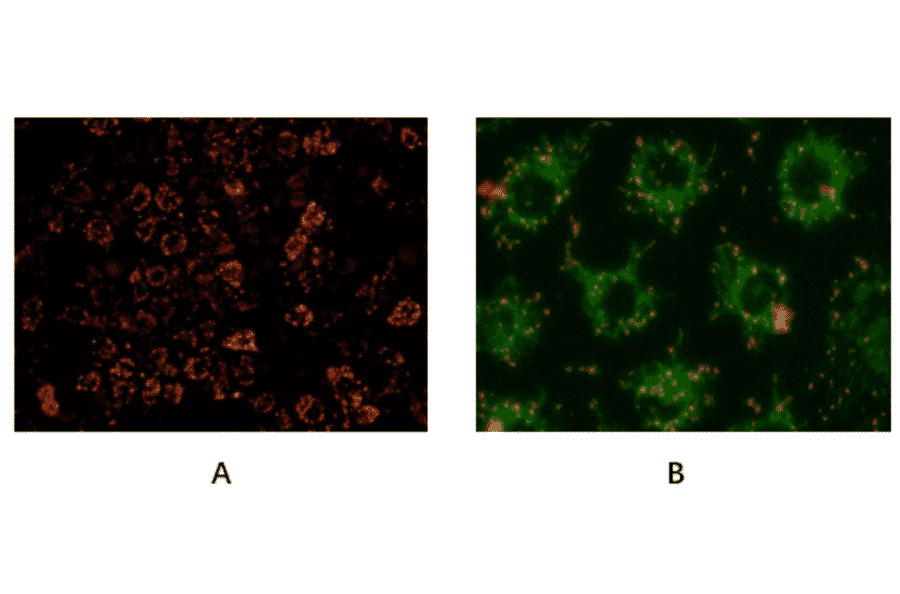
JC-1 accumulates in polarized mitochondria as red fluorescent aggregates, whereas depolarized mitochondria retain the dye in its green fluorescent monomeric form. The red-to-green fluorescence shift is used to assess changes in mitochondrial membrane potential.
Platform
Flow Cytometer, Fluorescence Microscope
Sample Type
Cultured cells
Assay Time
30-60 minutes
Components
JC-1 Stain, CCCP (10 mM), Assay Buffer (5X)
Storage
Shipped at 4°C. Refer to the Protocol Manual for storage conditions of individual components. Do not use past expiration date!
Disclaimer
This product is for research use only. It is not intended for diagnostic or therapeutic use.
Hela cells stained using Mitochondrial Membrane Potential Assay Kit (JC-1) (A319761). A: Red fluorescence indicates healthy mitochondria, B: Green fluorescence indicates mitochondria in poor health (30 minute incubation in 20 µM CCCP).
Publishing research using Mitochondrial Membrane Potential Assay Kit (JC-1) (A319761)? Please let us know so that we can list the citation on this page.