
| Sample Type | n | Range | Average |
|---|---|---|---|
| Serum | 10 | 88% - 102% | 97% |
| EDTA Plasma | 10 | 85% - 104% | 94% |
| Heparin Plasma | 10 | 86% - 95% | 92% |
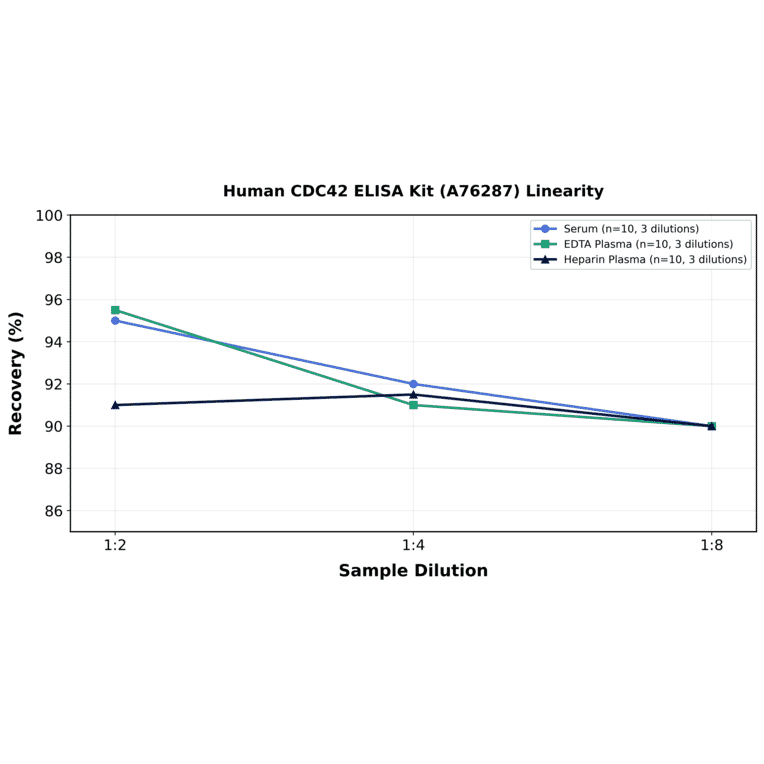
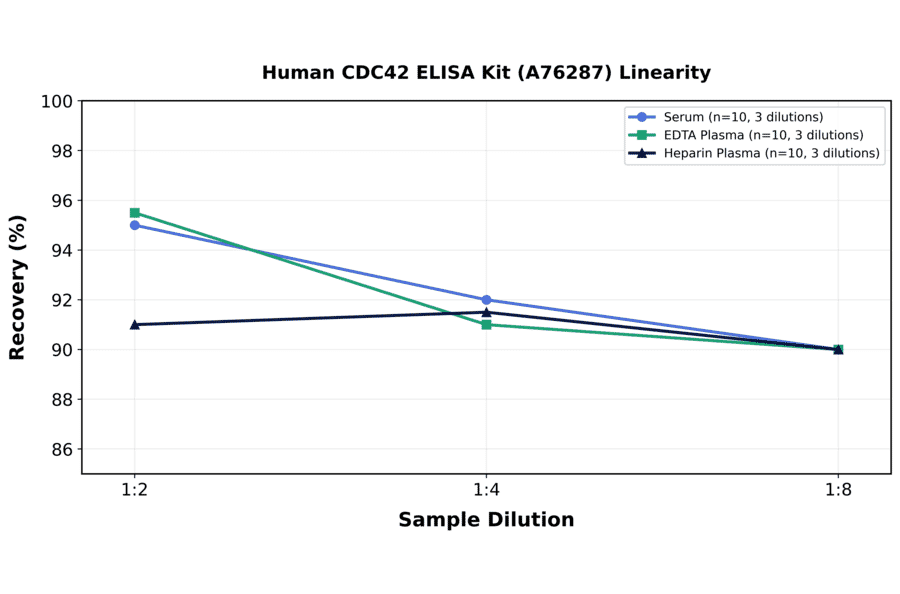
| Sample Type | n | 1:2 | 1:4 | 1:8 |
|---|---|---|---|---|
| Serum | 10 | 86-104% | 87-97% | 81-99% |
| EDTA Plasma | 10 | 88-103% | 85-97% | 82-98% |
| Heparin Plasma | 10 | 85-97% | 85-98% | 83-97% |
| Item | Quantity | Storage |
|---|---|---|
| Pre-Coated 96 Well Microplate | 12 x 8 Well Strips | +4°C |
| Lyopholized Standard | 2 Vials | +4°C |
| Sample Dilution Buffer | 20ml | +4°C |
| Biotinylated Detection Antibody | 120µl | +4°C |
| Antibody Dilution Buffer | 10ml | +4°C |
| HRP-Streptavidin Conjugate | 120µl | +4°C |
| SABC Dilution Buffer | 10ml | +4°C |
| TMB Substrate | 10ml | +4°C |
| Stop Solution | 10ml | +4°C |
| Wash Buffer (25X) | 30ml | +4°C |
| Plate Sealers | 5 Adhesive Strips | - |
| Foil Pouch | 1 Zip-Sealed Pouch | - |
Introduction: Critically ill patients commonly develop acquired neutrophil dysfunction, which increases susceptibility to intensive care unit-acquired infection (ICU-AI). This study aimed to assess whether interferon gamma (IFN-?) can restore function in dysfunctional neutrophils from critically ill patients and to uncover potential underlying mechanisms.
Methods: This was an observational cohort study. Neutrophils were isolated from whole blood donated by critically ill patients (n=31) in four separate teaching hospital intensive care units (ICUs). Neutrophils were subsequently treated with recombinant human IFN-? or vehicle for 1 hour following either Fc gamma receptor (Fc?R) blockade, selective inhibition of the gamma isoform of phosphoinositide 3-kinase (PI3K-?) or vehicle control for 30 min. Neutrophil phagocytosis, bacterial killing, superoxide generation, phagocytic receptor expression and small Rho GTPase activity were assessed. Neutrophil dysfunction was defined as <50% of cells ingesting 2 or more zymosan particles in a phagocytosis assay.
Results: IFN-? significantly improved phagocytosis (control 36.5%, IFN-? 56.0%), bacterial killing (control 31.6%, IFN-? 82.1%) and superoxide generation (2.8-fold increase relative to control) in dysfunctional neutrophils. IFN-? also increased the activity of the small GTPases, Rac and Cdc42 (2.4-fold and 1.5-fold increase relative to control, respectively) in dysfunctional neutrophils. Selective inhibition of PI3K-? prevented the IFN-?-mediated improvement of phagocytosis (IFN-? 62.5%, with inhibitor 27.9%), bacterial killing (IFN-? 82.1%, with inhibitor 30.5%) and superoxide generation (IFN-? 2.8-fold change relative to control, 0.7 with inhibitor). The IFN-?-mediated improvement of bacterial killing in dysfunctional neutrophils was also prevented by Fc?R blockade (IFN-? 82.1%, Fc?R inhibition 28.7%).
Conclusions: In critically ill patients with known acquired neutrophil dysfunction, ex vivo application of IFN-? consistently improved a range of neutrophil effector functions.