
| Sample Type | n | Range | Average |
|---|---|---|---|
| Serum | 10 | 88% - 105% | 98% |
| EDTA Plasma | 10 | 86% - 100% | 93% |
| Heparin Plasma | 10 | 85% - 97% | 90% |
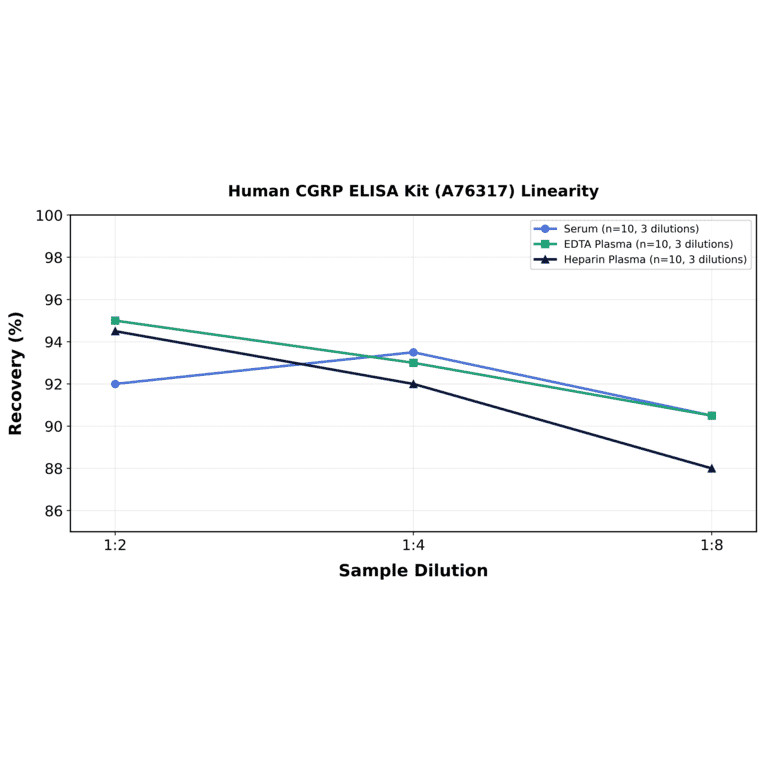
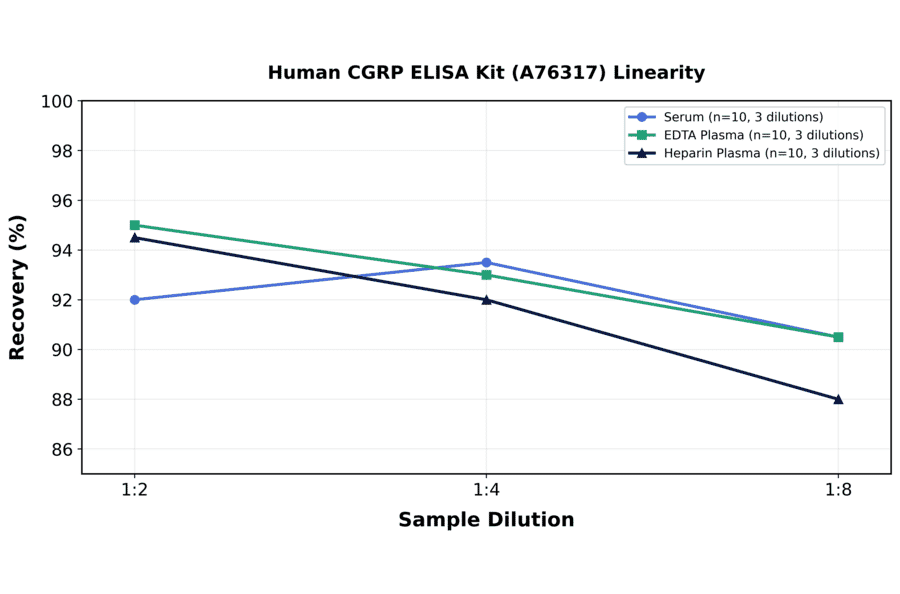
| Sample Type | n | 1:2 | 1:4 | 1:8 |
|---|---|---|---|---|
| Serum | 10 | 85-99% | 89-98% | 81-100% |
| EDTA Plasma | 10 | 89-101% | 86-100% | 81-100% |
| Heparin Plasma | 10 | 87-102% | 85-99% | 84-92% |
| Item | Quantity | Storage |
|---|---|---|
| Pre-Coated 96 Well Microplate | 12 x 8 Well Strips | +4°C |
| Lyopholized Standard | 2 Vials | +4°C |
| Sample Dilution Buffer | 20ml | +4°C |
| Biotinylated Detection Antibody | 120µl | +4°C |
| Antibody Dilution Buffer | 10ml | +4°C |
| HRP-Streptavidin Conjugate | 120µl | +4°C |
| SABC Dilution Buffer | 10ml | +4°C |
| TMB Substrate | 10ml | +4°C |
| Stop Solution | 10ml | +4°C |
| Wash Buffer (25X) | 30ml | +4°C |
| Plate Sealers | 5 Adhesive Strips | - |
| Foil Pouch | 1 Zip-Sealed Pouch | - |
Diabetic foot ulcers (DFUs) require rapid infection control alongside sustained regenerative signalling; however, co-delivery is hindered by different release requirements and peptide instability. A dual-compartment core-sheath dressing was fabricated by coaxial electrospinning, comprising a poly(e-caprolactone) (PCL) shell loaded with levofloxacin (LEV) and a poly(vinyl alcohol) (PVA) core encapsulating either insulin or calcitonin gene-related peptide (CGRP). Microscopy confirmed uniform, bead-free fibres with a well-defined core-sheath architecture. Encapsulation efficiencies were 92.97 ± 6.72% and 93.36 ± 5.36% for LEV, and 82.82 ± 12.46% (insulin) and 83.76 ± 8.25% (CGRP) for the peptide payloads. Drug loading improved mechanical performance, increasing the ultimate tensile strength from 7.05 ± 1.16 MPa (blank) to 8.80 ± 1.12 MPa (insulin) and 11.80 ± 1.63 MPa (CGRP). In phosphate-buffered saline (37 °C, pH 7.4), shell-loaded LEV showed a rapid (>91% within 4 h; ~96-98% by 8 h), whereas core-loaded insulin and CGRP were released over 7 days, reaching 88.05 ± 2.89% and 90.12 ± 5.71% cumulative release, respectively. Free-peptide controls exhibited marked time-dependent loss in measurable concentration, consistent with reduced apparent peptide loss during fibre-mediated release. LEV-loaded mats produced clear zones of inhibition against Staphylococcus aureus and Escherichia coli throughout 7 days. In this in vitro proof-of-concept study, this modular coaxial platform decouples antibiotic and peptide delivery to support sequential management of infection and tissue repair in infected chronic wounds, with diabetic foot ulcers as the intended clinical context.