
| Sample Type | n | Range | Average |
|---|---|---|---|
| Serum | 10 | 90% - 104% | 99% |
| EDTA Plasma | 10 | 87% - 97% | 91% |
| Heparin Plasma | 10 | 93% - 105% | 97% |
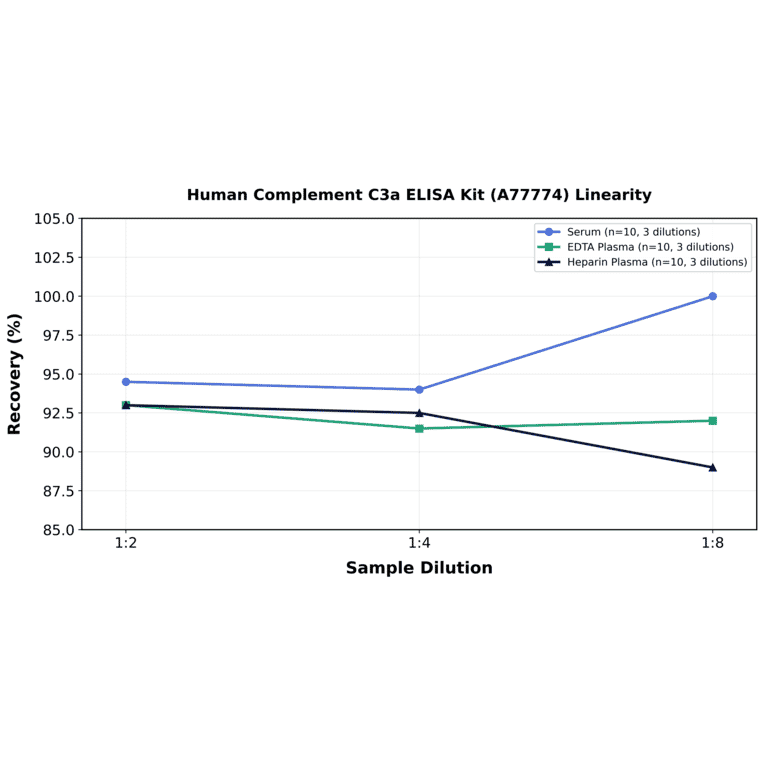
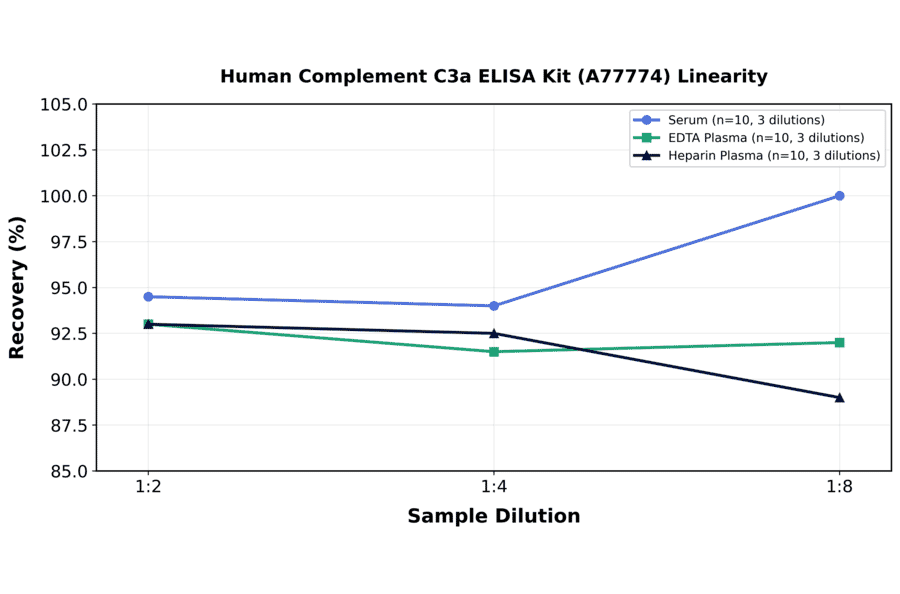
| Sample Type | n | 1:2 | 1:4 | 1:8 |
|---|---|---|---|---|
| Serum | 10 | 88-101% | 85-103% | 95-105% |
| EDTA Plasma | 10 | 85-101% | 84-99% | 86-98% |
| Heparin Plasma | 10 | 87-99% | 87-98% | 83-95% |
| Item | Quantity | Storage |
|---|---|---|
| Pre-Coated 96 Well Microplate | 12 x 8 Well Strips | +4°C |
| Lyopholized Standard | 2 Vials | +4°C |
| Sample Dilution Buffer | 20ml | +4°C |
| Biotinylated Detection Antibody | 120µl | +4°C |
| Antibody Dilution Buffer | 10ml | +4°C |
| HRP-Streptavidin Conjugate | 120µl | +4°C |
| SABC Dilution Buffer | 10ml | +4°C |
| TMB Substrate | 10ml | +4°C |
| Stop Solution | 10ml | +4°C |
| Wash Buffer (25X) | 30ml | +4°C |
| Plate Sealers | 5 Adhesive Strips | - |
| Foil Pouch | 1 Zip-Sealed Pouch | - |
Background: Reliable in-vitro thrombogenicity testing of medical devices requires large blood volumes, which cannot be obtained from humans. Slaughterhouse blood is an ethically acceptable, cost-effective alternative. While porcine blood is already used in hemolysis testing, its use for thrombogenicity testing remains limited regarding its comparability to human blood.
Objectives: This study systematically characterizes porcine slaughterhouse in comparison to human blood regarding key parameters relevant for thrombogenicity testing. The goal is to evaluate its suitability for standardized in-vitro tests.
Methods: Human donor and porcine slaughterhouse blood were analyzed for key thrombogenicity parameters. These included coagulation markers (ROTEM parameters, TAT, fibrinogen), platelet and complement activation (PLAs, P-selectin, C3a, SC5b9), and stress-related hormones (adrenaline, cortisol). The influence of two different anticoagulants (enoxaparin and citrate) was also assessed.
Results: Despite moderate pre-activation in pig blood - especially for platelets, complement and stress markers - intact reaction patterns were observed. Exemplarily, ROTEM analysis revealed species-specific characteristics such as reduced clotting time (CT) and increased clot strength (A30) in pigs, while overall reactivity was preserved. In addition, porcine platelets maintained their responsiveness to agonists, suggesting that further activation is possible despite the increased baseline. Importantly, the effect of anticoagulants (citrate vs. enoxaparin) was the same in both species, suggesting that the methodological scope used in in-vitro assays is transferable.
Conclusions: These results emphasize that, when properly collected and handled, slaughterhouse porcine blood can be a viable and reliable alternative to human blood for thrombogenicity testing, although certain baseline differences must be taken into account.
Statement of significance: Reliable in-vitro testing of the thrombogenicity of medical devices is crucial for their safety, but requires large volumes of blood that often cannot be covered by conventional human blood donations. This study provides for the first time a comprehensive characterization of pig slaughterhouse blood compared to human blood with regard to hematological, inflammatory and coagulation-related parameters. The results show which properties are comparable and which differences need to be taken into account. The work thus lays the foundation for the establishment of an ethically justifiable and practical thrombogenicity model - an important step towards animal-free thrombogenicity tests in the development of blood-contacting medical products.