| Sample Type | n | Range | Average |
|---|---|---|---|
| Serum | 10 | 88% - 105% | 96% |
| EDTA Plasma | 10 | 90% - 105% | 92% |
| Heparin Plasma | 10 | 88% - 100% | 97% |
| Sample Type | n | 1:2 | 1:4 | 1:8 |
|---|---|---|---|---|
| Serum | 10 | 86-103% | 84-100% | 83-94% |
| EDTA Plasma | 10 | 85-96% | 80-95% | 85-101% |
| Heparin Plasma | 10 | 82-96% | 83-97% | 85-100% |
| Item | Quantity | Storage |
|---|---|---|
| Pre-Coated 96 Well Microplate | 12 x 8 Well Strips | +4°C |
| Lyopholized Standard | 2 Vials | +4°C |
| Sample Dilution Buffer | 20ml | +4°C |
| Biotinylated Detection Antibody | 120µl | +4°C |
| Antibody Dilution Buffer | 10ml | +4°C |
| HRP-Streptavidin Conjugate | 120µl | +4°C |
| SABC Dilution Buffer | 10ml | +4°C |
| TMB Substrate | 10ml | +4°C |
| Stop Solution | 10ml | +4°C |
| Wash Buffer (25X) | 30ml | +4°C |
| Plate Sealers | 5 Adhesive Strips | - |
| Foil Pouch | 1 Zip-Sealed Pouch | - |
Background: Differences in gene expression between inflammatory-like (iEOS-like) and resident-like (rEOS-like) eosinophil subtypes, and in eosinophil-derived serum mediators, may reflect eosinophil functional activity and their potential role in the pathogenesis of allergic asthma (AA).
Methods: Twenty-three patients with non-severe AA and thirteen healthy subjects (HS) were examined. AA patients underwent a bronchial allergen challenge (BAC) with Dermatophagoides pteronyssinus and were re-evaluated 24 h later. Blood eosinophils were isolated by gradient centrifugation and magnetic separation, followed by subtyping based on CD62L expression. Gene expression was assessed by TaqMan-based quantitative PCR. Serum eosinophil cationic protein (ECP), eosinophil-derived neurotoxin (EDN), Galectin-10 (Gal10), and NADPH oxidase 2 (NOX2) were measured using ELISA.
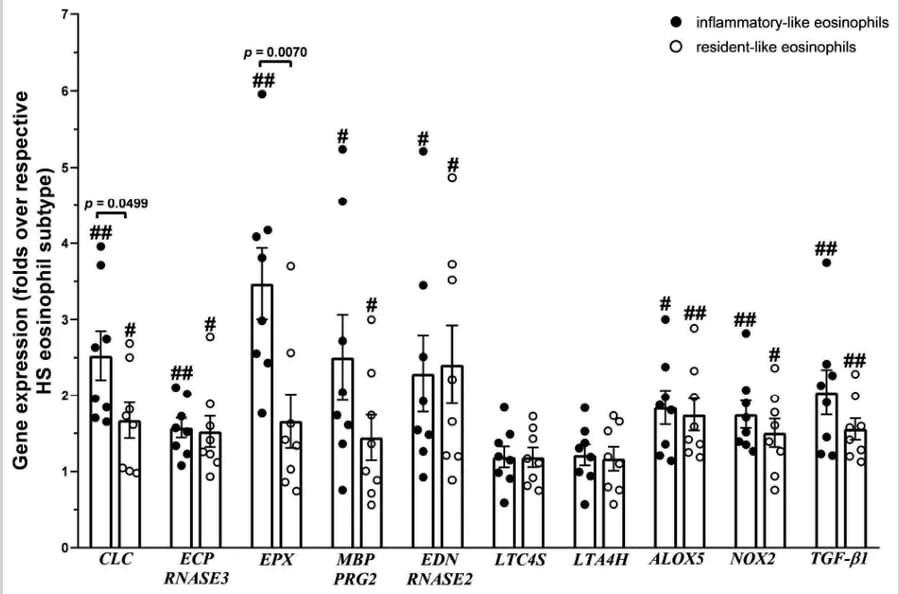
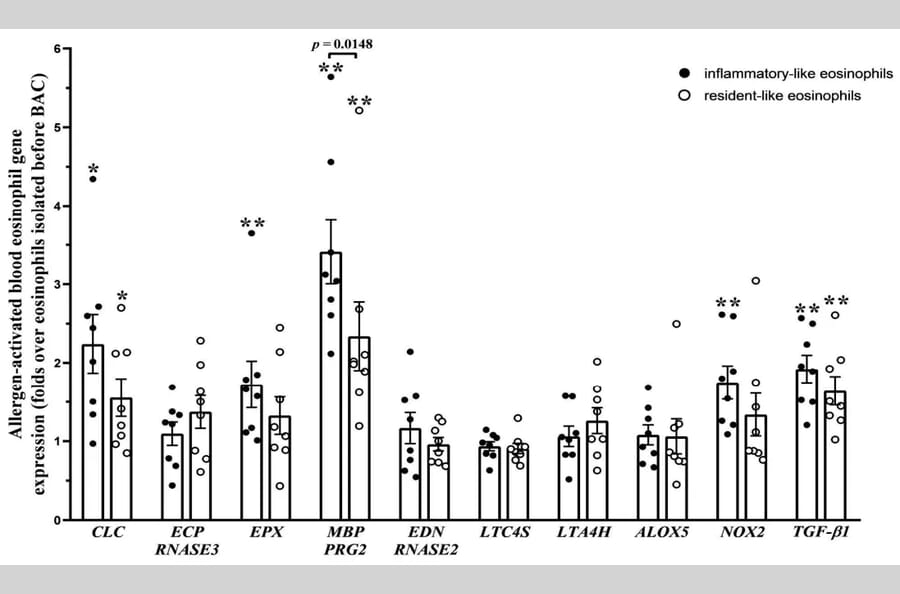
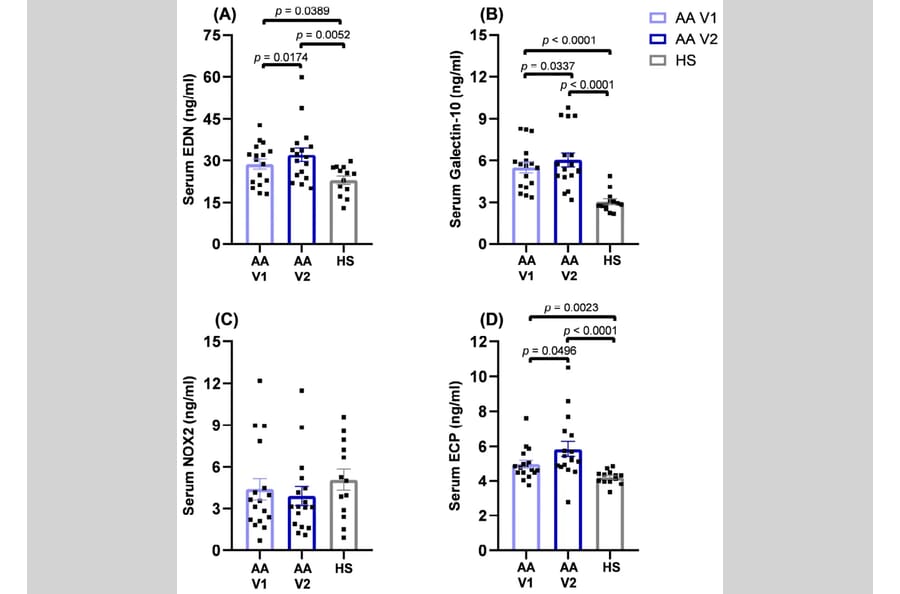
Results: Blood eosinophil subtypes from AA patients showed significantly higher expression of CLC, ECP, EPX, EDN, MBP, ALOX5, NOX2, and TGF-ß1 compared to those from HS (p < 0.05), with no significant changes in LTA4H and LTC4S. iEOS-like cells in AA patients exhibited higher CLC and EPX expression compared to rEOS-like cells, (p < 0.05). Following BAC, CLC, MBP, and TGF-ß1 expression increased in both eosinophil subtypes, while EPX and NOX2 increased only in iEOS-like cells (all p < 0.05). Serum ECP, EDN, and Gal10 concentrations were elevated in AA compared to HS and further increased after BAC (all p < 0.05); serum NOX2 remained unchanged.
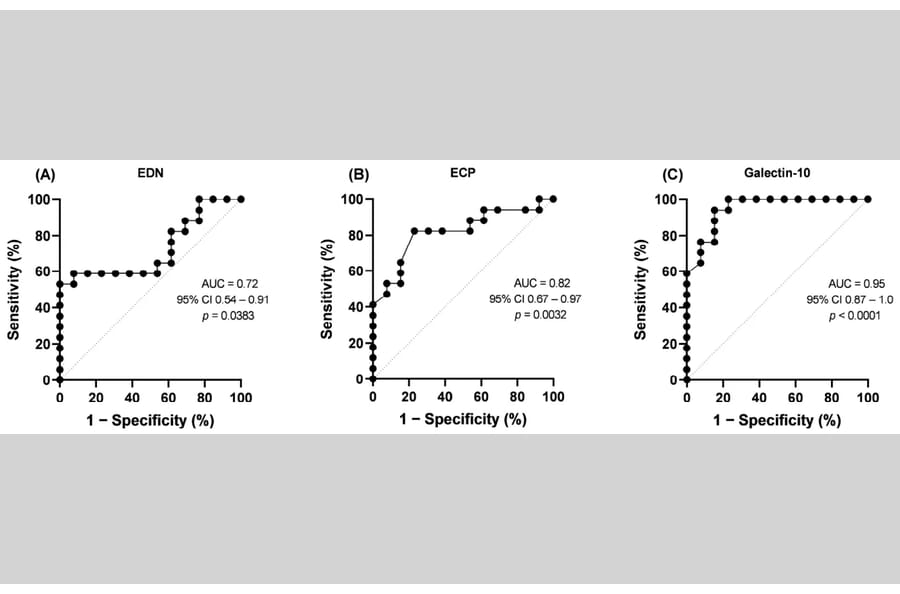
Conclusions: BAC induces a late-phase eosinophilic response in AA characterized by a partially eosinophil subtype-specific increase in gene expression and in circulating eosinophil-derived mediators. An increase in Gal10, observed at the CLC transcript level in eosinophils and in serum-but not in ECP or EDN-suggests the existence of mediator-specific mechanisms that regulate gene expression and extracellular release.