
| Sample Type | n | Range | Average |
|---|---|---|---|
| Serum | 5 | 80% - 102% | 91% |
| EDTA Plasma | 5 | 81% - 100% | 90% |
| Heparin Plasma | 5 | 80% - 89% | 84% |
| Sample Type | 1:2 | 1:4 | 1:8 | 1:16 |
|---|---|---|---|---|
| Serum (n=5) | 87-91% | 87-107% | 74-101% | 92-97% |
| EDTA Plasma (n=5) | 90-105% | 84-101% | 90-101% | 79-108% |
| Heparin Plasma (n=5) | 84-95% | 92-105% | 82-105% | 89-91% |
| Item | Quantity | Storage |
|---|---|---|
| Pre-Coated 96 Well Microplate | 12 x 8 Well Strips | -20°C |
| Lyopholized Standard | 2 Vials | -20°C |
| Detection Solution A | 120μl | -20°C |
| Detection Solution B | 120µl | -20°C |
| Wash Buffer (30X) | 20ml | +4°C |
| Sample Dilution Buffer | 45ml | -20°C |
| TMB Substrate | 9ml | +4°C |
| Stop Solution | 6ml | +4°C |
| Plate Sealers | 5 Adhesive Strips | - |
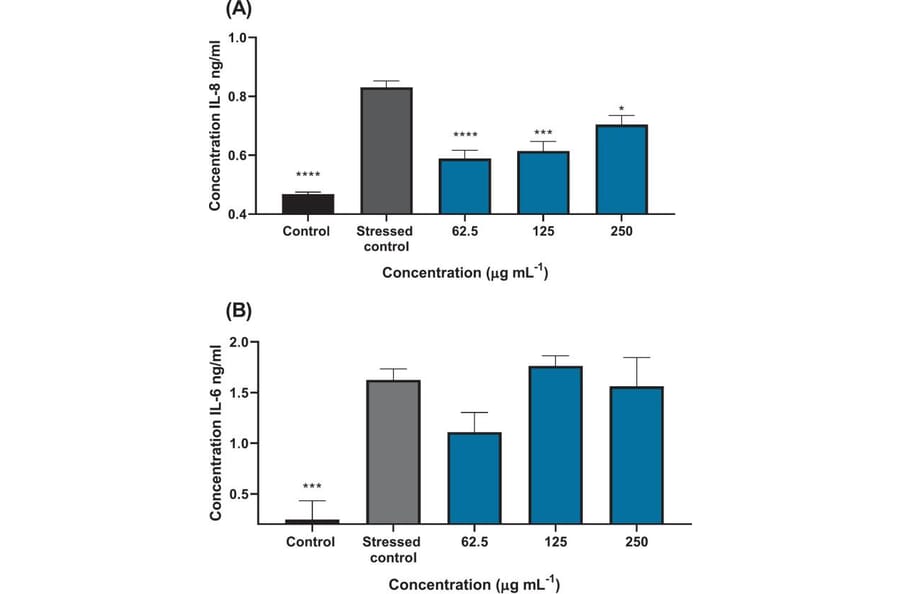
Essential oils, natural volatile products extracted from aromatic plants, exhibit a wide range of biological activities, including antimicrobial and antiparasitic properties. Anisakis simplex is a parasitic nematode commonly found in marine fish, which poses a significant health risk to humans through the consumption of raw or undercooked seafood, leading to anisakiasis, a zoonotic disease with both gastrointestinal and allergic manifestations. In this study, the impact of Crithmum maritimum L. (Apiaceae) essential oil on this nematode was evaluated in vitro. The chemical composition of C. maritimum essential oil was determined by gas chromatography-mass spectrometry (GC-MS). The analysis revealed ?-terpinene, limonene, and sabinene as the major components. The nematicidal activity, larval penetration ability, resistance to acidic pH, and inhibition of acetylcholinesterase were evaluated. The essential oil effects on interleukin production and cytotoxicity in HepG2 and Caco-2 cells were also assessed. C. maritimun exhibited larvicidal activity, with LD50 values of 619.11 µg mL-1 at 24 h and 353.95 µg mL-1 at 48 h. Additionally, it showed no significant cytotoxicity in HepG2 and Caco-2 cell lines at the concentrations tested. In Caco-2 cells stimulated with crude Anisakis extract, the essential oil modulated interleukin production. Furthermore, it demonstrated in vitro inhibitory activity against 5-lipoxygenase and phospholipase A2, with IC50 values of 99.35 and 253.31 µg mL-1, respectively. The traditional culinary use of C. maritimum, together with the observed anti-Anisakis activity in our study, suggest this essential oil may offer a promising complementary approach within broader integrated food safety strategies, especially in Anisakis control.