
| Sample Type | n | Range | Average |
|---|---|---|---|
| Serum | 5 | 83% - 100% | 91% |
| EDTA Plasma | 5 | 91% - 102% | 96% |
| Heparin Plasma | 5 | 89% - 102% | 95% |
| Sample Type | 1:2 | 1:4 | 1:8 | 1:16 |
|---|---|---|---|---|
| Serum (n=5) | 75-104% | 90-98% | 82-104% | 84-99% |
| EDTA Plasma (n=5) | 95-102% | 83-110% | 85-94% | 89-105% |
| Heparin Plasma (n=5) | 72-102% | 91-94% | 92-105% | 82-104% |
| Item | Quantity | Storage |
|---|---|---|
| Pre-Coated 96 Well Microplate | 12 x 8 Well Strips | -20°C |
| Lyopholized Standard | 2 Vials | -20°C |
| Detection Solution A | 120μl | -20°C |
| Detection Solution B | 120µl | -20°C |
| Wash Buffer (30X) | 20ml | +4°C |
| Sample Dilution Buffer | 45ml | -20°C |
| TMB Substrate | 9ml | +4°C |
| Stop Solution | 6ml | +4°C |
| Plate Sealers | 5 Adhesive Strips | - |
Purpose: To evaluate the prognostic significance of serum gp100 levels in patients with uveal melanoma (UM) without detectable metastases at diagnosis.
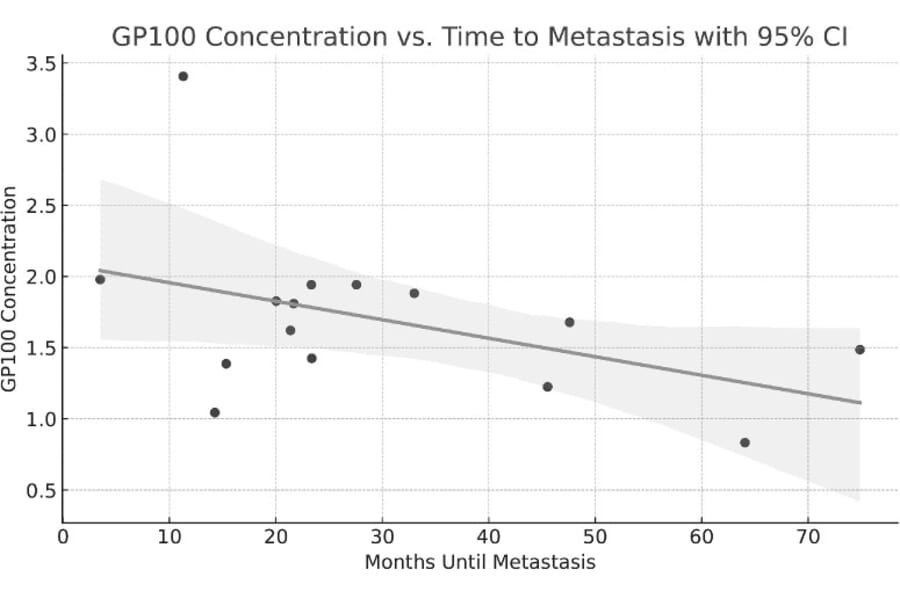
Methods: This prospective study included 37 patients with UM and no clinical evidence of metastasis at baseline. Serum gp100 concentration was quantified using a commercial ELISA kit. Tumors were molecularly profiled and categorized into high- or low-risk classes. Patients were stratified based on the median gp100 concentration (1.23 ng/mL). Survival analysis was performed using Kaplan-Meier estimates, and multivariate logistic regression was used to identify independent predictors of metastasis.
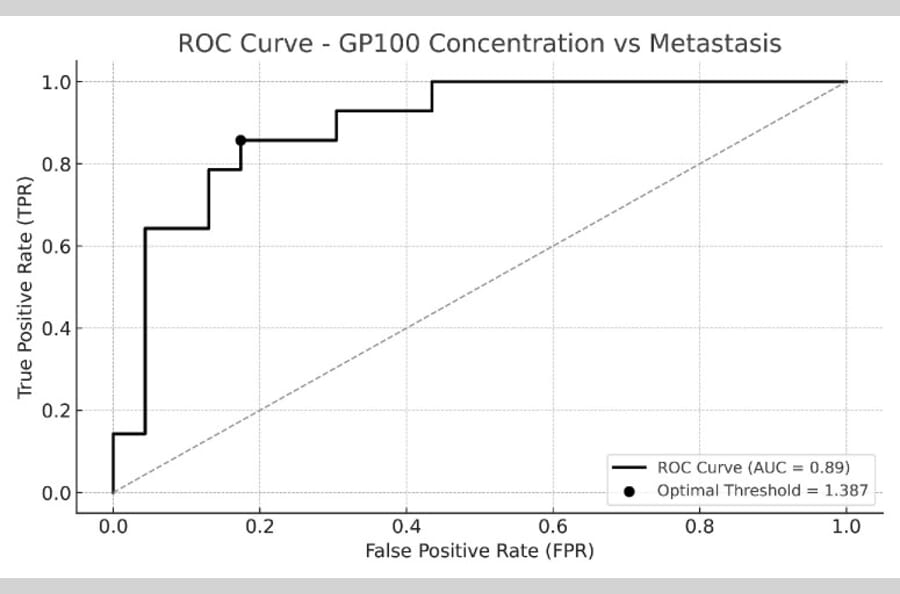
Results: During a mean follow-up of 24.6 months, 14 patients (37.8%) developed metastases. Patients with baseline gp100 >1.23 ng/mL had significantly shorter metastasis-free survival (P < 0.001). Receiver operating characteristic (ROC) analysis yielded an area under the curve of 0.89, with a cutoff of 1.387 ng/mL, achieving 85.7% sensitivity and 82.6% specificity. In multivariate analysis, serum gp100 remained an independent predictor of metastasis (odds ratio = 3849.9; 95% confidence interval, 9.66-1,534,206; P = 0.007), regardless of molecular classification. No significant correlations were found between gp100 and clinical or genetic parameters.
Conclusions: Elevated serum gp100 is an independent biomarker of early metastatic risk in UM, even in the absence of clinical or genetic high-risk features. ELISA-based measurement of gp100 may support noninvasive stratification and personalized surveillance strategies in clinical practice.