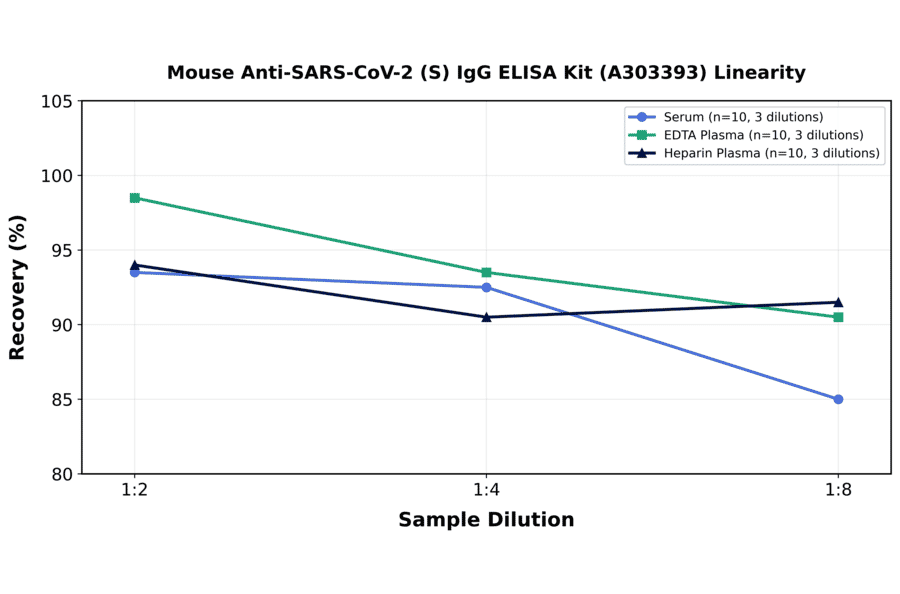

| Sample Type | n | Range | Average |
|---|---|---|---|
| Serum | 10 | 85% - 104% | 92% |
| EDTA Plasma | 10 | 90% - 103% | 98% |
| Heparin Plasma | 10 | 94% - 104% | 100% |
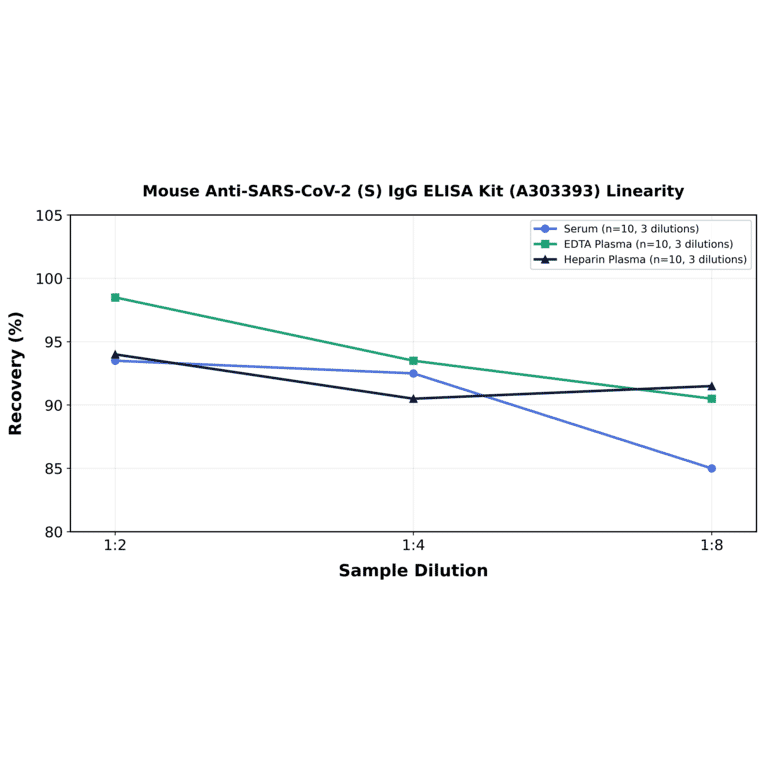
| Sample Type | n | 1:2 | 1:4 | 1:8 |
|---|---|---|---|---|
| Serum | 10 | 85-102% | 84-101% | 80-90% |
| EDTA Plasma | 10 | 93-104% | 87-100% | 81-100% |
| Heparin Plasma | 10 | 85-103% | 87-94% | 84-99% |
Circular dichroism is a useful tool to study the impact of mRNA sequence optimization on mRNA structure. mRNA can fold into several conformations according to the sequence of nucleotides. Structural characteristics of mRNA (melting temperature, unfolding trajectories) are important for their biological function. Circular dichroism is a powerful technique to characterize mRNA structure. In this chapter we describe how to analyze protein coding mRNA by Synchrotron Radiation Circular Dichroism (SRCD). The emphasis is put on mRNA synthesis and sample preparation, which are critical for mRNA analysis. We also provide a protocol for the in vivo evaluation of vaccine activity.
Messenger RNA (mRNA) has emerged as an attractive new technology of drugs. The efficacy of mRNA technology depends on both the efficiency of mRNA delivery and translation. Untranslated regions (UTRs) and the poly(A) tail play a crucial role in regulating mRNA intracellular kinetics. Intending to improve the therapeutic potential of synthetic mRNA, we evaluated various UTRs and tail designs, using Pfizer-BioNTech coronavirus disease 2019 (COVID-19) vaccine sequences as a reference. First, we screened six 5' UTRs (cap-dependent/-independent), evaluated nine 5' UTR-3' UTR combinations, and a novel heterologous A/G tail in cell models, and in vivo using luciferase as a reporter gene. Then, to decipher the translation mechanism of selected UTRs, we correlated mRNA expression with ribosome load, mRNA half-life, mRNA immunogenicity, and UTR structures. Our results showed that the heterologous tail we introduced is as potent as the Pfizer-BioNTech tail and confirmed the high potency of the human a-globin 5' UTR. They also revealed the potential of the VP6 and SOD 3' UTRs. We validated our results using mRNA encoding the SARS-CoV-2 spike protein formulated as lipid nanoparticles (LNPs) for mouse immunization. Overall, the selected 3' UTRs and heterologous A/G tail have great potential as new elements for therapeutic mRNA design.