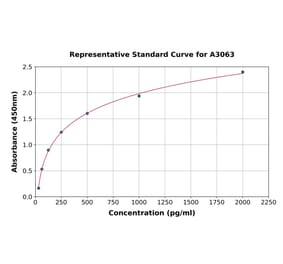

| Sample Type | n | Range | Average |
|---|---|---|---|
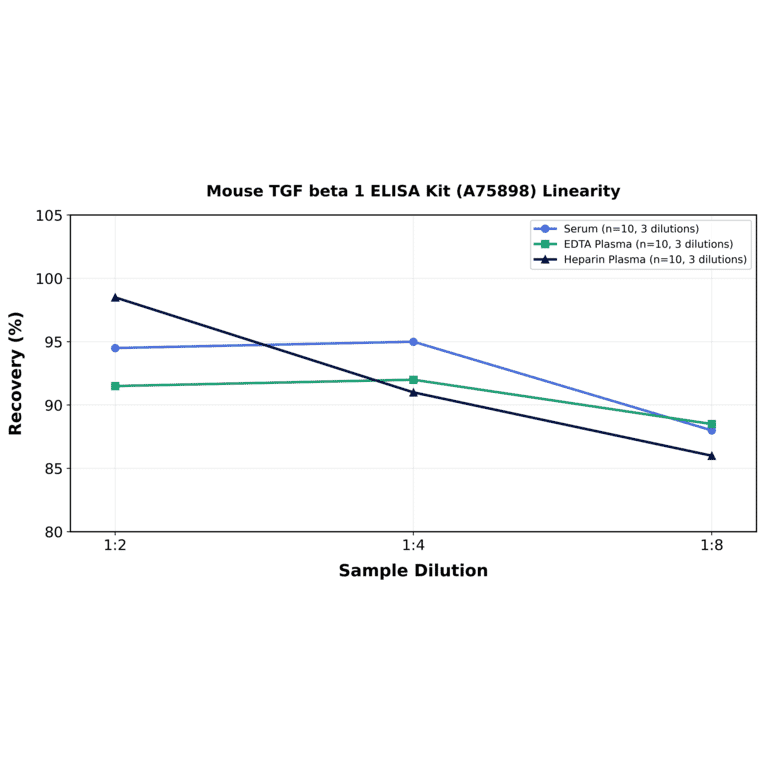
| Serum | 10 | 85% - 104% | 92% |
| EDTA Plasma | 10 | 92% - 102% | 98% |
| Heparin Plasma | 10 | 87% - 101% | 92% |
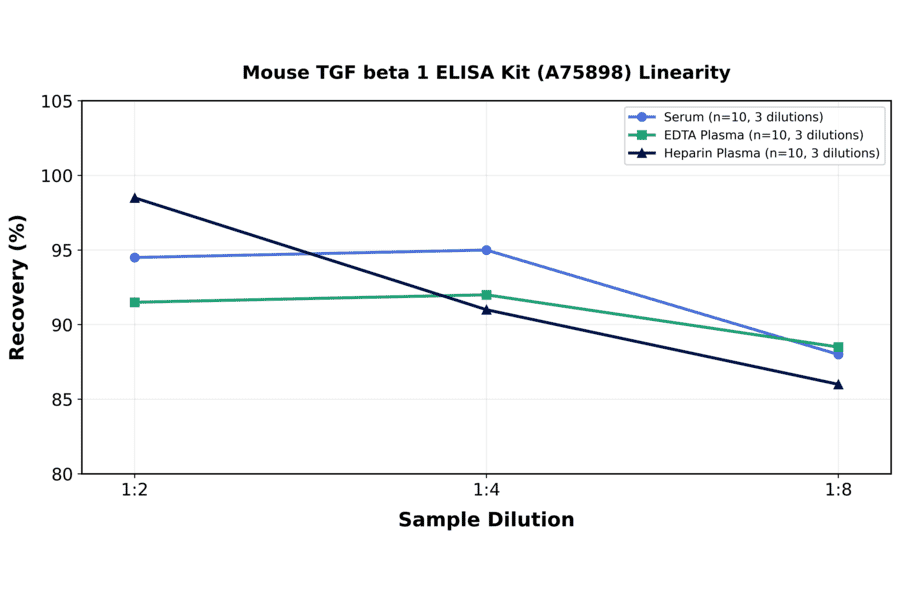
| Sample Type | n | 1:2 | 1:4 | 1:8 |
|---|---|---|---|---|
| Serum | 10 | 85-104% | 90-100% | 86-90% |
| EDTA Plasma | 10 | 85-98% | 83-101% | 80-97% |
| Heparin Plasma | 10 | 92-105% | 85-97% | 80-92% |
| Item | Quantity | Storage |
|---|---|---|
| Pre-Coated 96 Well Microplate | 12 x 8 Well Strips | +4°C |
| Lyopholized Standard | 2 Vials | +4°C |
| Sample Dilution Buffer | 20ml | +4°C |
| Biotinylated Detection Antibody | 120µl | +4°C |
| Antibody Dilution Buffer | 10ml | +4°C |
| HRP-Streptavidin Conjugate | 120µl | +4°C |
| SABC Dilution Buffer | 10ml | +4°C |
| TMB Substrate | 10ml | +4°C |
| Stop Solution | 10ml | +4°C |
| Wash Buffer (25X) | 30ml | +4°C |
| Plate Sealers | 5 Adhesive Strips | - |
| Foil Pouch | 1 Zip-Sealed Pouch | - |
Objective: Aloin, the main active component in Aloe vera (L.) Burm. f., has shown promising anti-tumor effects. This study investigated the impact of aloin in lung squamous cell carcinoma (LUSC) and explored its functional mechanism.
Methods: We analyzed the viability, migration, invasion, proliferation, and apoptosis of two LUSC cell lines after treatment with aloin. Target molecules of aloin and downstream target transcripts of nuclear receptor subfamily 3 group C member 2 (NR3C2) were predicted by bioinformatics. The biological functions of NR3C2 and metallothionein 1 M (MT1M) in the malignant properties of LUSC cells were determined. A co-culture system of LUSC cells with monocyte-derived macrophages was constructed. Mouse xenograft tumor models were generated to analyze the functions of aloin and NR3C2 in the tumorigenic activity of LUSC cells and macrophage polarization in vivo.
Results: Aloin suppressed malignant properties of LUSC cells in vitro. However, these effects were negated by the silencing of NR3C2. NR3C2 was found to activate MT1M transcription by binding to its promoter. Additional upregulation of MT1M suppressed the malignant behavior of LUSC cells augmented by NR3C2 silencing. Analysis of the M1 and M2 markers/cytokines in the macrophages or the culture supernatant revealed that aloin treatment or MT1M overexpression in LUSC cells enhanced M1 polarization while suppressing M2 polarization of macrophages, whereas NR3C2 silencing led to reverse trends. Consistent findings were reproduced in vivo.
Conclusion: This study demonstrated that aloin activates the NR3C2/MT1M axis to suppress the malignant behavior of LUSC cells and M2 macrophage polarization. Please cite this article as: Chen YN, Lu JY, Gao CF, Fang ZR, Zhou Y. Aloin blocks the malignant behavior of lung squamous cell carcinoma cells and M2 macrophage polarization by modulating the NR3C2/MT1M axis. J Integr Med. 2025; 23(2): 195-208.