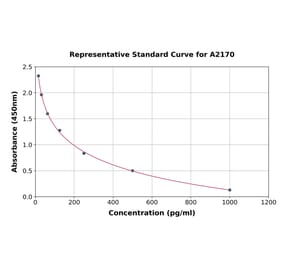

| Sample Type | n | Range | Average |
|---|---|---|---|
| Serum | 10 | 85% - 94% | 91% |
| EDTA Plasma | 10 | 92% - 96% | 94% |
| Heparin Plasma | 10 | 94% - 100% | 98% |
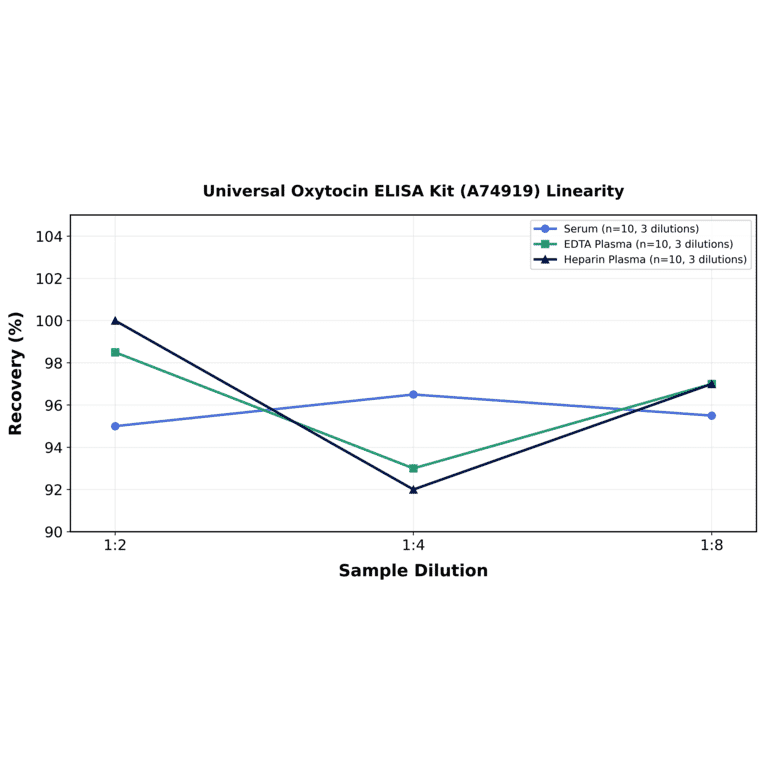
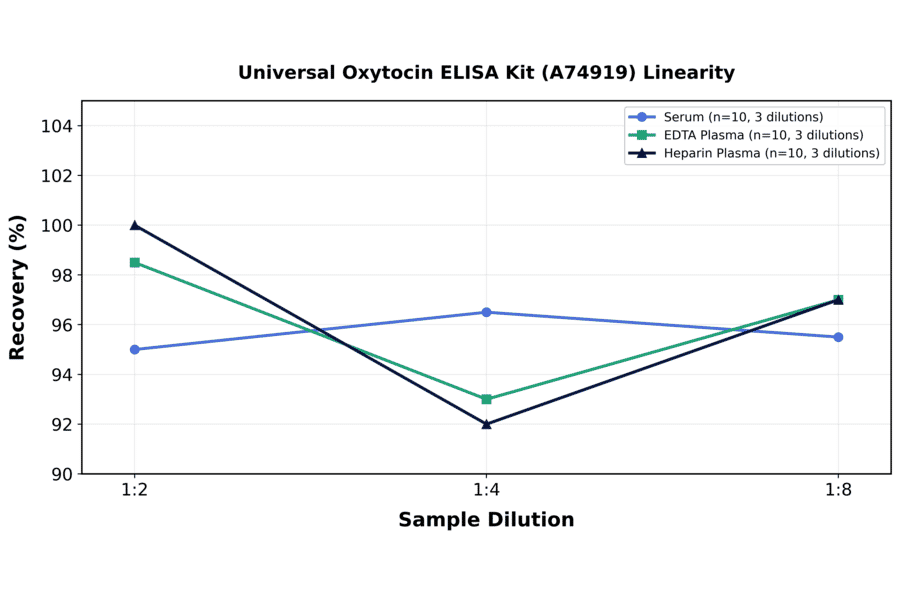
| Sample Type | n | 1:2 | 1:4 | 1:8 |
|---|---|---|---|---|
| Serum | 10 | 89-101% | 93-100% | 91-100% |
| EDTA Plasma | 10 | 92-105% | 89-97% | 95-99% |
| Heparin Plasma | 10 | 96-104% | 87-97% | 94-100% |
| Item | Quantity | Storage |
|---|---|---|
| Pre-Coated 96 Well Microplate | 12 x 8 Well Strips | +4°C |
| Lyopholized Standard | 2 Vials | +4°C |
| Sample Dilution Buffer | 20ml | +4°C |
| Biotinylated Detection Antibody | 60µl | +4°C |
| Antibody Dilution Buffer | 10ml | +4°C |
| HRP-Streptavidin Conjugate | 120µl | +4°C |
| SABC Dilution Buffer | 10ml | +4°C |
| TMB Substrate | 10ml | +4°C |
| Stop Solution | 10ml | +4°C |
| Wash Buffer (25X) | 30ml | +4°C |
| Plate Sealers | 5 Adhesive Strips | - |
| Foil Pouch | 1 Zip-Sealed Pouch | - |
Purpose: Obesity is a complex heterogeneous disease often associated with dysfunctional eating behavior patterns. Oxytocin (OT) is a neurohormone involved in the regulation of energy metabolism and eating behavior. The aim of the present study was to evaluate in a population of patients with obesity circulating levels of OT and dysfunctional eating behaviors in relation to anthropometric, hormonal and metabolic parameters.
Methods: A prospective, observational, single-center study was conducted at the Center of High Specialization for the Care of Obesity of Sapienza University of Rome. Adult subjects with body mass index (BMI) = 30 kg/m2 were recruited. Body impedance assessment (BIA), biochemical and hormonal parameters, plasma OT concentration analysis and the Eating Behaviors Assessment for Obesity (EBA-O) questionnaire were evaluated.
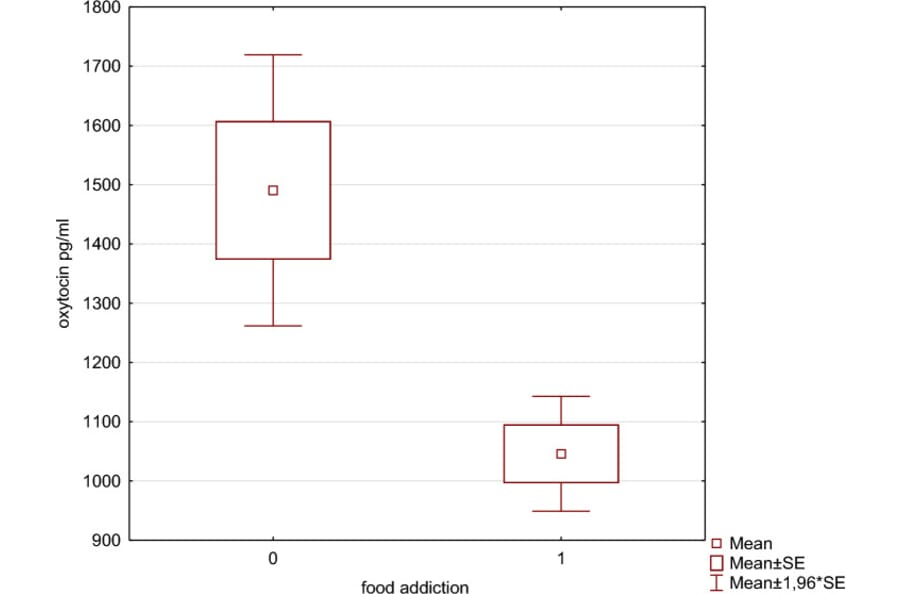
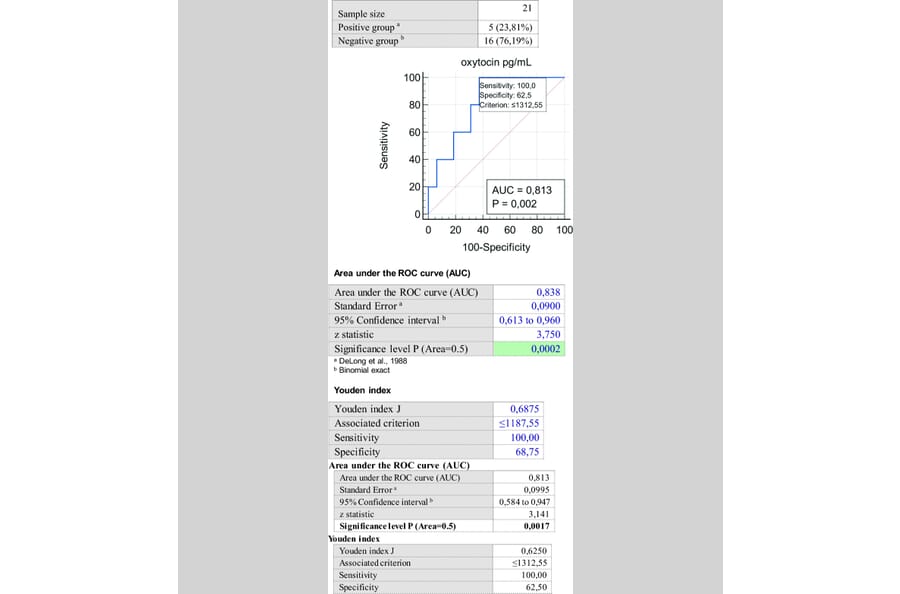
Results: A total of 21 patients, 16 females and 5 males, with a mean age of 45.7 ± 15.1 years, mean BMI of 40.89 ± 8.02 kg/m2 and plasma OT concentration of 1365.61 ± 438.03 pg/mL were recruited. The dysfunctional eating behavior traits investigated by the EBA-O appear significantly associated with metabolic derangements. In particular, night eating is associated with alterations in lipid metabolism (p < 0.01). Circulating OT correlates positively with BMI (r = 0,43; p < 0.05), and Hepatic Steatosis Index (HIS) (r = 0.46; p < 0.05), while its role in subjects with obesity and alterations in glucose metabolism is less clear. Interestingly, circulating OT levels < 1312.55 pg/mL may be predictive of food addiction (100% sensitivity; 62.5% specificity).
Conclusions: Despite the need for larger studies to confirm their validity, the clinical utility of the EBA-O and circulating OT in identifying dysfunctional eating behaviors appears promising.