
| Sample Type | n | Range | Average |
|---|---|---|---|
| Serum | 10 | 95% - 105% | 98% |
| EDTA Plasma | 10 | 86% - 101% | 93% |
| Heparin Plasma | 10 | 92% - 103% | 97% |
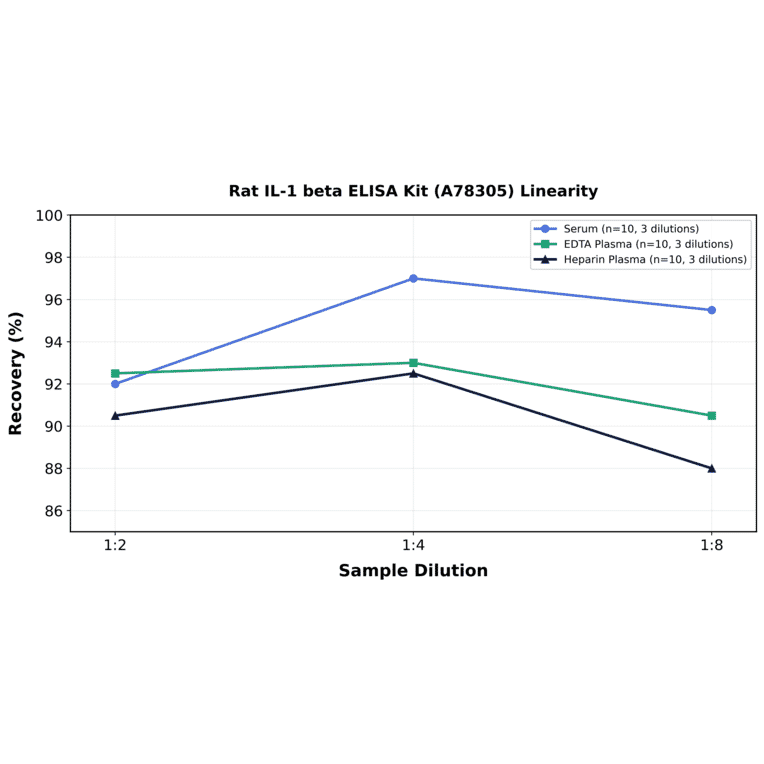
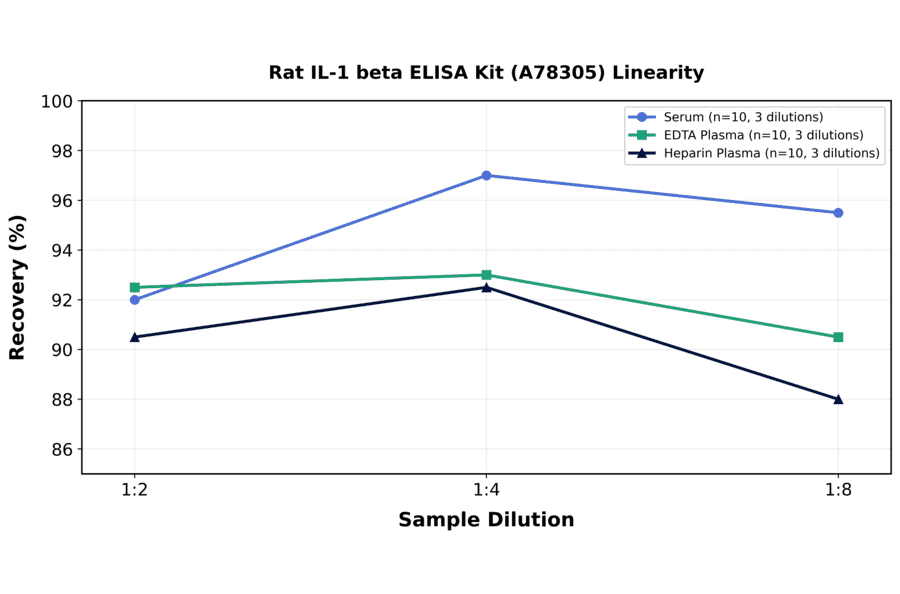
| Sample Type | n | 1:2 | 1:4 | 1:8 |
|---|---|---|---|---|
| Serum | 10 | 86-98% | 93-101% | 92-99% |
| EDTA Plasma | 10 | 86-99% | 85-101% | 82-99% |
| Heparin Plasma | 10 | 83-98% | 85-100% | 81-95% |
| Item | Quantity | Storage |
|---|---|---|
| Pre-Coated 96 Well Microplate | 12 x 8 Well Strips | +4°C |
| Lyopholized Standard | 2 Vials | +4°C |
| Sample Dilution Buffer | 20ml | +4°C |
| Biotinylated Detection Antibody | 120µl | +4°C |
| Antibody Dilution Buffer | 10ml | +4°C |
| HRP-Streptavidin Conjugate | 120µl | +4°C |
| SABC Dilution Buffer | 10ml | +4°C |
| TMB Substrate | 10ml | +4°C |
| Stop Solution | 10ml | +4°C |
| Wash Buffer (25X) | 30ml | +4°C |
| Plate Sealers | 5 Adhesive Strips | - |
| Foil Pouch | 1 Zip-Sealed Pouch | - |
Background: In addition to their primary lipid-lowering effects, statins also exhibit pleiotropic properties, including anti-inflammatory, immunomodulatory, antimicrobial, antioxidative, and angiogenic effects, all of which promote wound healing. Rosuvastatin, a synthetic hydrophilic statin, has recently been proposed to enhance wound healing by stimulating angiogenesis and accelerating tissue regeneration. Its hydrophilic nature, longer half-life, greater hepatoselectivity, and better efficacy/safety than other statins are believed to contribute to its superior efficacy in wound repair, as suggested by promising preliminary results. However, current data on its use remain limited, necessitating further preclinical and clinical studies to thoroughly investigate this novel treatment option for burns.
Aim: To investigate the effects of rosuvastatin and its mechanism of action on burn wound healing process in an experimental study.
Methods: Ninety male Wistar albino rats aged 12-16 weeks were randomly assigned to three groups of 30, subjected to burn using specific stainless steel sealer. Burn eschar was removed the following day applying topical rosuvastatin cream (study), Eucerin cream (placebo), normal saline (control), and sterile wound dressing. Each group was divided into three subgroups of ten according to sacrifice day (3rd, 6th, 9th). C-reactive protein (CRP), tumor necrosis factor-alpha (TNF-a), interleukin (IL)-1ß, IL-6, digital assessment of burn healing, and histopathology were performed.
Results: Using the value on the third day in the control group as the baseline, reductions were measured on the sixth and ninth days. Similarly, reduction values were recorded on the third, sixth, and ninth days in the study group. A statistically significant reduction was observed in the study group compared to the control group, with greater reductions corresponding to later sacrifice days (3rd, 6th, and 9th) in CRP (P < 0.01), TNF-a (P < 0.01), IL-1ß (P < 0.01), and IL-6 (P < 0.01) levels and burn size (P < 0.01). Histopathology revealed a statistically significant reduction in inflammatory infiltration, coagulative necrosis, and microhemorrhage (P < 0.01). Conversely, statistically significant increases in neovascularization (P = 0.012) and fibroblastic reactions (P = 0.023) were noted. No adverse effects or deaths were observed.
Conclusion: Rosuvastatin reduces inflammation by lowering TNF-a, IL-1ß, IL-6, CRP while increasing neo-angiogenesis, fibroblast reactions and microenvironmental protection in burn wounds. These effects promote repair and positively impact burn wound healing.
Background: Hepatic ischemia-reperfusion injury (HIRI) remains one of the major causes of postoperative liver dysfunction following extensive hepatectomy and liver transplantation. Owing to its progressive and dynamic nature, HIRI may lead to multiple organ failure and a worsened outcome. Treprostinil is a relatively new synthetic prostacyclin analog with a potential beneficial effect against HIRI. Ischemic preconditioning (IP) is a promising method to protect against HIRI.
Aim: To investigate HIRI biomarkers, their effects on liver and heart, and the effects of treprostinil and IP on these processes.
Methods: Forty male Wistar albino rats aged 3-4 months were randomly assigned to four groups of ten, subjected to a 3-hour surgical intervention, and then sacrificed. Hepatic ischemia was induced by clamping the hepatoduodenal ligament for 30 minutes, followed by reperfusion for 120 minutes. Treprostinil (100 ng/kg/minute for 24 hours) or IP before HIRI, no protection, and a sham operation were applied accordingly in each group. Liver and heart histopathology and specific serum and hepatic tissue biomarkers were assessed.
Results: HIRI deteriorated hepatocellular function and exacerbated liver and myocardial damage in the control group. Furthermore, HIRI triggered cytokine overexpression and protein carbonyl content (P < 0.001). Compared with those in the HIRI group, lower troponin I, tumor necrosis factor-a, endothelin-1, and interleukin-1ß in serum and liver tissue were significantly correlated with reduced cellular necrosis and improved hepatocellular function in the treprostinil group (P < 0.001). Similar but less pronounced effects were observed in the IP group. Both treprostinil and IP had protective effects in hepatic and cardiac tissues. However, treprostinil showed slightly superior cardioprotective efficacy, as evidenced by a statistically significant difference in troponin I levels (P < 0.05) and histopathological scoring of myocardium samples, but there were no differences in the other parameters.
Conclusion: HIRI results in oxidative stress and cytokine overexpression, which deteriorate hepatic function and accelerates myocardial damage. Treprostinil and IP are promising strategies for preventing reperfusion-induced cellular and systemic damage.