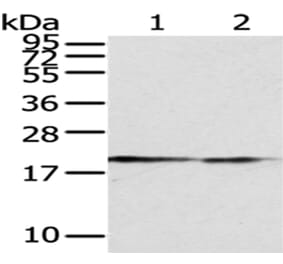
Mouse monoclonal [PCRP-POLE3-3D3] antibody to CHRAC17.
Specificity
DNA replication is initiated by the binding of initiation factors to the origin of replication. Nucleosomes inhibit access to the replication machinery at these origin sequences. Nucleosome remodeling factors increase the accessibility of nucleosomal DNA to transcriptional regulators. CHRAC15 and CHRAC17 are subunits of the nucleosomal remodeling factor CHRAC (chromatin accessibility complex), which increases the accessibility of nucleosomal DNA in an ATP-dependent manner. Unlike other known chromatin remodeling factors, CHRAC also functions during chromatin assembly by using ATP to convert irregular chromatin into a regular array of nucleosomes with even spacing. This conversion process occurs when CHRAC organizes randomly deposited histones into a regularly spaced array. In the presence of CHRAC, the nucleosomal ATPase ISWI catalyzes several ATP-dependent transitions of chromatin structure.
SDS-PAGE analysis of Anti-CHRAC17 Antibody [PCRP-POLE3-3D3] under non-reduced and reduced conditions; showing intact IgG and intact heavy and light chains, respectively. SDS-PAGE analysis confirms the integrity and purity of the antibody.
Flow cytometric analysis of PFA-fixed HeLa cells using Anti-CHRAC17 Antibody [PCRP-POLE3-3D3] followed by Goat Anti-Mouse IgG (CF® 488) (Blue). Unstained cells (Red).
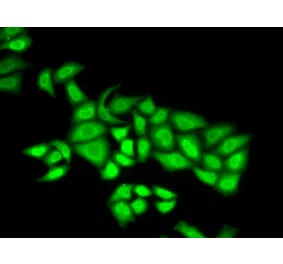
Immunofluorescent analysis of PFA-fixed HeLa cells stained with Anti-CHRAC17 Antibody [PCRP-POLE3-3D3] followed by Goat Anti-Mouse IgG (CF® 488) (Green). CF® 640R Phalloidin (Red).
Analysis of protein array containing more than 19,000 full-length human proteins using Anti-CHRAC17 Antibody [PCRP-POLE3-3D3]. Z-Score and S- Score: The Z-score represents the strength of a signal that a monoclonal antibody (MAb) (in combination with a fluorescently-tagged anti-IgG secondary antibody) produces when binding to a particular protein on the HuProtTM array. Z-scores are described in units of standard deviations (SD's) above the mean value of all signals generated on that array. If targets on HuProtTM are arranged in descending order of the Z-score, the S-score is the difference (also in units of SD's) between the Z-score. S-score therefore represents the relative target specificity of a MAb to its intended target; a MAb is considered to be specific to its intended target, if the MAb has an S-score of at least 2.5. For example, if a MAb binds to protein X with a Z-score of 43 and to protein Y with a Z-score of 14, then the S-score for the binding of that MAb to protein X is equal to 29.
Publishing research using Anti-CHRAC17 Antibody [PCRP-POLE3-3D3] (A277753)? Please let us know so that we can list the citation on this page.
Alternative products to Anti-CHRAC17 Antibody [PCRP-POLE3-3D3] (A277753)


![SDS-PAGE - Anti-CHRAC17 Antibody [PCRP-POLE3-3D3] (A277753) - Antibodies.com](https://cdn.antibodies.com/image/catalog/277/A277753_1.jpg?profile=product_top)
![Flow Cytometry - Anti-CHRAC17 Antibody [PCRP-POLE3-3D3] (A277753) - Antibodies.com](https://cdn.antibodies.com/image/catalog/277/A277753_2.jpg?profile=product_top)
![Immunofluorescence - Anti-CHRAC17 Antibody [PCRP-POLE3-3D3] (A277753) - Antibodies.com](https://cdn.antibodies.com/image/catalog/277/A277753_3.jpg?profile=product_top)
![Protein Array - Anti-CHRAC17 Antibody [PCRP-POLE3-3D3] (A277753) - Antibodies.com](https://cdn.antibodies.com/image/catalog/277/A277753_4.jpg?profile=product_top)
![SDS-PAGE - Anti-CHRAC17 Antibody [PCRP-POLE3-3D3] (A277753) - Antibodies.com](https://cdn.antibodies.com/image/catalog/277/A277753_1.jpg?profile=product_top_thumb)
![Flow Cytometry - Anti-CHRAC17 Antibody [PCRP-POLE3-3D3] (A277753) - Antibodies.com](https://cdn.antibodies.com/image/catalog/277/A277753_2.jpg?profile=product_top_thumb)
![Immunofluorescence - Anti-CHRAC17 Antibody [PCRP-POLE3-3D3] (A277753) - Antibodies.com](https://cdn.antibodies.com/image/catalog/277/A277753_3.jpg?profile=product_top_thumb)
![Protein Array - Anti-CHRAC17 Antibody [PCRP-POLE3-3D3] (A277753) - Antibodies.com](https://cdn.antibodies.com/image/catalog/277/A277753_4.jpg?profile=product_top_thumb)
![SDS-PAGE - Anti-CHRAC17 Antibody [PCRP-POLE3-3D3] (A277753) - Antibodies.com](https://cdn.antibodies.com/image/catalog/277/A277753_1.jpg?profile=product_image)
![Flow Cytometry - Anti-CHRAC17 Antibody [PCRP-POLE3-3D3] (A277753) - Antibodies.com](https://cdn.antibodies.com/image/catalog/277/A277753_2.jpg?profile=product_image)
![Immunofluorescence - Anti-CHRAC17 Antibody [PCRP-POLE3-3D3] (A277753) - Antibodies.com](https://cdn.antibodies.com/image/catalog/277/A277753_3.jpg?profile=product_image)
![Protein Array - Anti-CHRAC17 Antibody [PCRP-POLE3-3D3] (A277753) - Antibodies.com](https://cdn.antibodies.com/image/catalog/277/A277753_4.jpg?profile=product_image)
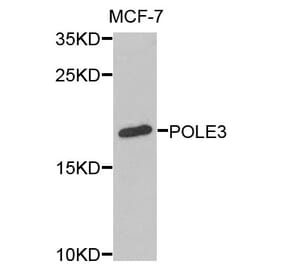
![SDS-PAGE - Anti-CHRAC17 Antibody [PCRP-POLE3-3D3] - BSA and Azide free (A278341) - Antibodies.com](https://cdn.antibodies.com/image/catalog/278/A278341_1.jpg?profile=product_alternative)
![Flow Cytometry - Anti-CHRAC17 Antibody [PCRP-POLE3-2F10] (A253213) - Antibodies.com](https://cdn.antibodies.com/image/catalog/249/A249641_1.jpg?profile=product_alternative)
![Flow Cytometry - Anti-CHRAC17 Antibody [PCRP-POLE3-2F10] - BSA and Azide free (A249641) - Antibodies.com](https://cdn.antibodies.com/image/catalog/252/A252821_1.jpg?profile=product_alternative)