This antibody recognises ovarian cancer G protein-coupled receptor 1 (OGR1), a seven pass transmembrane protein initially cloned from an ovarian cancer cell line. OGR1 has a wide expression, and selectively binds both protons and bioactive lipids.OGR1 functions as a proton-sensing G protein-coupled receptor stimulating inositol phosphate production and Ca2+ mobilisation. It is also a receptor for sphingophosphorylcholine and related lysolipids, which antagonise the proton-induced actions mediated by OGR1.OGR1 is also expressed early during osteoclastogenesis and plays a role in osteoclast differentiation.
Applications
IHC-P
Dilutions
IHC-P 1: 20 µg/ml
Reactivity
Human, Mouse
Immunogen
Synthetic peptide corresponding to the N-terminal domain of human OGR1, conjugated to Keyhole Limpet Haemocyanin.
Host
Rabbit
Clonality
Polyclonal
Isotype
IgG
Conjugate
Unconjugated
Concentration
1 mg/ml
Product Form
Liquid
Formulation
Supplied in Phosphate Buffered Saline with <0.1% Sodium Azide.
Storage
Shipped at ambient temperature. Upon delivery aliquot and store at -20°C. When thawed, aliquot the sample as needed. Short term (up to 4 weeks): store at 4°C. Long term: store at -20°C. Avoid freeze / thaw cycles. Storage in frost free freezers is not recommended.
General Notes
Rabbit anti Human OGR1 antibody detects ovarian cancer G protein-coupled receptor 1 (OGR1), a seven pass transmembrane protein initially cloned from an ovarian cancer cell line. OGR1 has a wide expression, and selectively binds both protons and bioactive lipids.OGR1 functions as a proton-sensing G protein-coupled receptor stimulating inositol phosphate production and Ca2+ mobilisation. It is also a receptor for sphingophosphorylcholine and related lysolipids, which antagonise the proton-induced actions mediated by OGR1.OGR1 is also expressed early during osteoclastogenesis and plays a role in osteoclast differentiation.





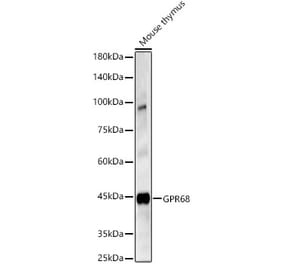
![SDS-PAGE - Anti-OGR1 Nanobody [SAA1363] (A337958) - Antibodies.com](https://cdn.antibodies.com/image/catalog/337/A337958_1.jpg?profile=product_alternative)