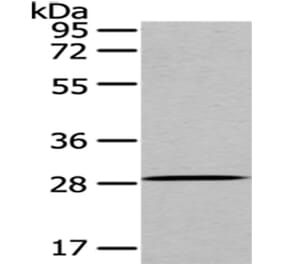
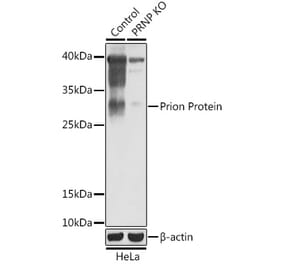
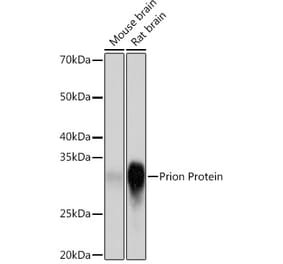
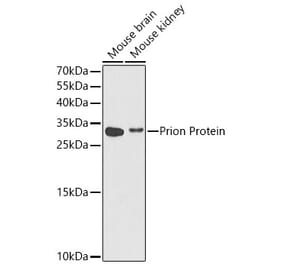
Mouse monoclonal [ROS-1H9] antibody to Prion Protein PrP.
Specificity
This antibody recognises the prion disease form of prion protein known as CD230. Transmissible spongiform encephalopathies (TSEs) or prion diseases are fatal infectious neurodegenerative diseases of humans and animals and known as Scrapie (sheep and goats), BSE (cattle), CWD (cervine/deer ) and CJD (humans). These diseases are biologically unique, as they are believed by some to be transmitted by an infectious agent comprised only of protein, with no nucleic acid component. Clinically, these diseases present with motor disturbances and behavioral changes. The major pathological changes seen are neuronal loss, vacuolation (spongiform change), proliferation and branching of glial cells, astrocytic proliferation and accumulation of the prion protein PrPSc, which can form amyloid plaques. CD230. also known as the prion protein (PrP) exists in two alternate forms; a normal cellular form (PrPc) and a disease-associated form (PrPSc).The normal and pathological forms of the prion protein have identical amino acid sequences and differ only in their folded tertiary structure and biochemical properties.
Applications
WB, IHC-P, Flow Cytometry
Reactivity
Sheep, Bovine, Human, Hamster, Mouse, Red deer
Immunogen
A truncated form of recombinant sheep PRP spanning amino acids 94-233.
Protein G affinity chromatography of tissue culture supernatant.
Concentration
1 mg/ml
Product Form
Liquid
Formulation
Supplied in Phosphate Buffered Saline with <0.1% Sodium Azide.
Storage
Shipped at ambient temperature. Upon delivery aliquot and store at -20°C. When thawed, aliquot the sample as needed. Short term (up to 4 weeks): store at 4°C. Long term: store at -20°C. Avoid freeze / thaw cycles. Storage in frost free freezers is not recommended.
General Notes
Mouse anti Sheep CD230 (Prpsc) antibody, clone ROS-1H9 recognizes the prion disease form of prion protein known as CD230. Transmissible spongiform encephalopathies (TSEs) or prion diseases are fatal infectious neurodegenerative diseases of humans and animals and known as Scrapie (sheep and goats), BSE (cattle), CWD (cervine/deer ) and CJD (humans). These diseases are biologically unique, as they are believed by some to be transmitted by an infectious agent comprised only of protein, with no nucleic acid component. Clinically, these diseases present with motor disturbances and behavioral changes. The major pathological changes seen are neuronal loss, vacuolation (spongiform change), proliferation and branching of glial cells, astrocytic proliferation and accumulation of the prion protein PrPSc, which can form amyloid plaques. CD230. also known as the prion protein (PrP) exists in two alternate forms; a normal cellular form (PrPc) and a disease-associated form (PrPSc).The normal and pathological forms of the prion protein have identical amino acid sequences and differ only in their folded tertiary structure and biochemical properties.
Synonyms
Alternative prion protein; major prion protein, AltPrP, ASCR, CD230, CD230 antigen, CJD, GSS, KURU, Major prion protein, p27 30, Prion protein, Prion related protein, PRIO_HUMAN, PRIP, PRNP, PrP, PrP27 30, PrP27-30, PrP33-35C, PrPC, PrPSc, Sinc