
Unconjugated
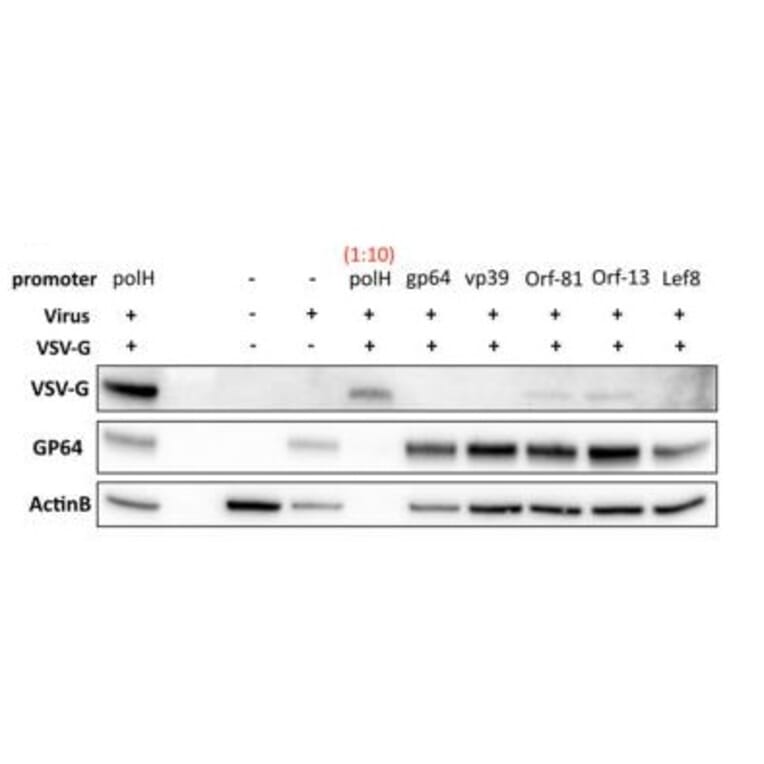
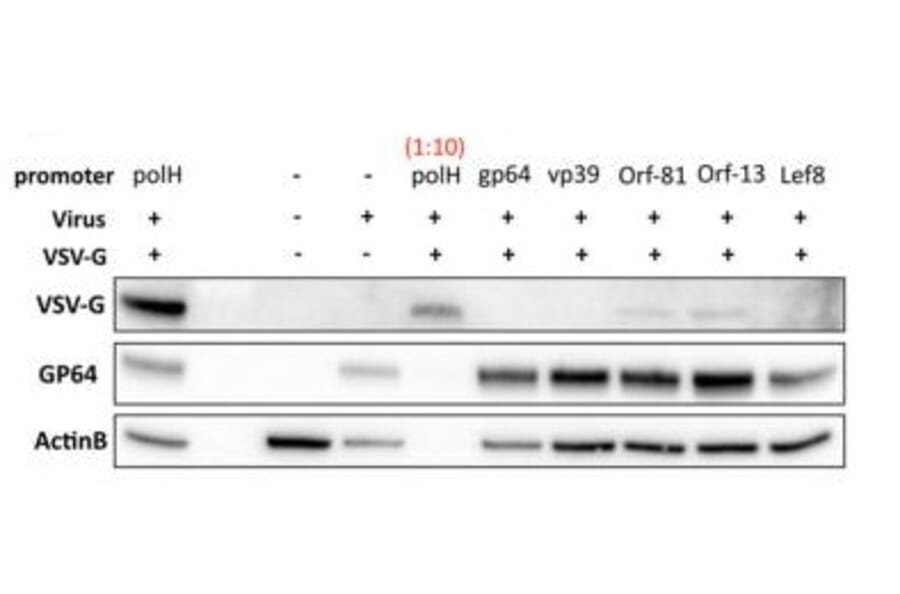
Baculoviral vectors (BVs) derived from Autographa californica multiple nucleopolyhedrovirus (AcMNPV) are an attractive tool for multigene delivery in mammalian cells, which is particularly relevant for CRISPR technologies. Most applications in mammalian cells rely on BVs that are pseudotyped with vesicular stomatitis virus G-protein (VSV-G) to promote efficient endosomal release. VSV-G expression typically occurs under the control of the hyperactive polH promoter. In this study, we demonstrate that polH-driven VSV-G expression results in BVs characterised by reduced stability, impaired morphology, and VSV-G induced toxicity at high multiplicities of transduction (MOTs) in target mammalian cells. To overcome these drawbacks, we explored five alternative viral promoters with the aim of optimising VSV-G levels displayed on the pseudotyped BVs. We report that Orf-13 and Orf-81 promoters reduce VSV-G expression to less than 5% of polH, rescuing BV morphology and stability. In a panel of human cell lines, we elucidate that BVs with reduced VSV-G support efficient gene delivery and CRISPR-mediated gene editing, at levels comparable to those obtained previously with polH VSV-G-pseudotyped BVs (polH VSV-G BV). These results demonstrate that VSV-G hyperexpression is not required for efficient transduction of mammalian cells. By contrast, reduced VSV-G expression confers similar transduction dynamics while substantially improving BV integrity, structure, and stability.
CRISPR-based DNA editing technologies enable rapid and accessible genome engineering of eukaryotic cells. However, the delivery of genetically encoded CRISPR components remains challenging and sustained Cas9 expression correlates with higher off-target activities, which can be reduced via Cas9-protein delivery. Here we demonstrate that baculovirus, alongside its DNA cargo, can be used to package and deliver proteins to human cells. Using protein-loaded baculovirus (pBV), we demonstrate delivery of Cas9 or base editors proteins, leading to efficient genome and base editing in human cells. By implementing a reversible, chemically inducible heterodimerization system, we show that protein cargoes can selectively and more efficiently be loaded into pBVs (spBVs). Using spBVs we achieved high levels of multiplexed genome editing in a panel of human cell lines. Importantly, spBVs maintain high editing efficiencies in absence of detectable off-targets events. Finally, by exploiting Cas9 protein and template DNA co-delivery, we demonstrate up to 5% site-specific targeted integration of a 1.8 kb heterologous DNA payload using a single spBV in a panel of human cell lines. In summary, we demonstrate that spBVs represent a versatile, efficient and potentially safer alternative for CRISPR applications requiring co-delivery of DNA and protein cargoes.