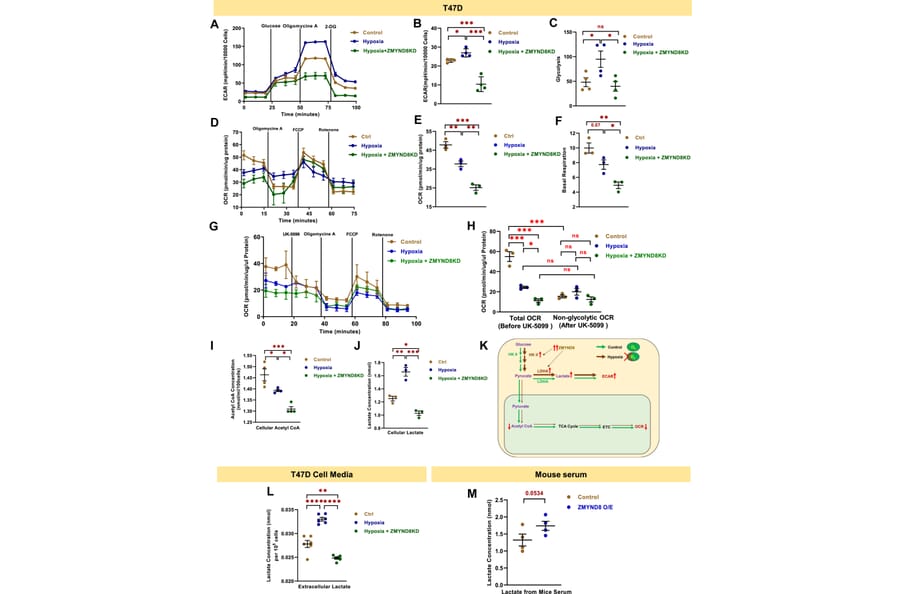

Breast cancer, a leading cause of mortality, exhibits significant heterogeneity across molecular subtypes, with tumor hypoxia contributing to poor therapeutic outcomes. The present study investigates the role of ZMYND8, a hypoxia-responsive epigenetic factor, in regulating carbohydrate metabolism in concert with HIF1a in breast cancer. In adherent cells as well as in 3D MCTS, ZMYND8 expression is elevated under hypoxic conditions. Furthermore, immunohistochemistry analysis also shows that ZMYND8 and HIF1a expression are positively correlated in breast cancer. Remarkably, ZMYND8 is found to regulate glycolysis in hypoxic breast cancer cells as well as in 4T1-induced breast tumors in mice, elevating the expression of hexokinase II (HKII) and lactate dehydrogenase A. Notably, ZMYND8 directly regulates the transcription of lactate dehydrogenase A by promoting the recruitment of S5-phosphorylated RNA polymerase II to its promoter region. Metabolic-flux analysis, along with acetyl CoA and lactate pool measurements confirm that ZMYND8 bifurcate the metabolic axis toward anaerobic glycolysis, leading to the increase of extracellular acidification in hypoxic conditions. Interestingly, ZMYND8-induced changes in metabolic intermediate lactate in breast cancer cells, as well as in mouse serum, significantly impact the immune cell invasion and CD8+ T cell activity in the tumor microenvironment. These results highlight ZMYND8 as a key player in hypoxia-induced metabolic reprogramming of breast cancer cells and provide new insights into the epigenetic regulation of cancer metabolism. Our study unveils a novel mechanism linking epigenetics, metabolism, and immune evasion in breast cancer, opening new avenues for targeted therapeutic interventions aimed at disrupting this axis.