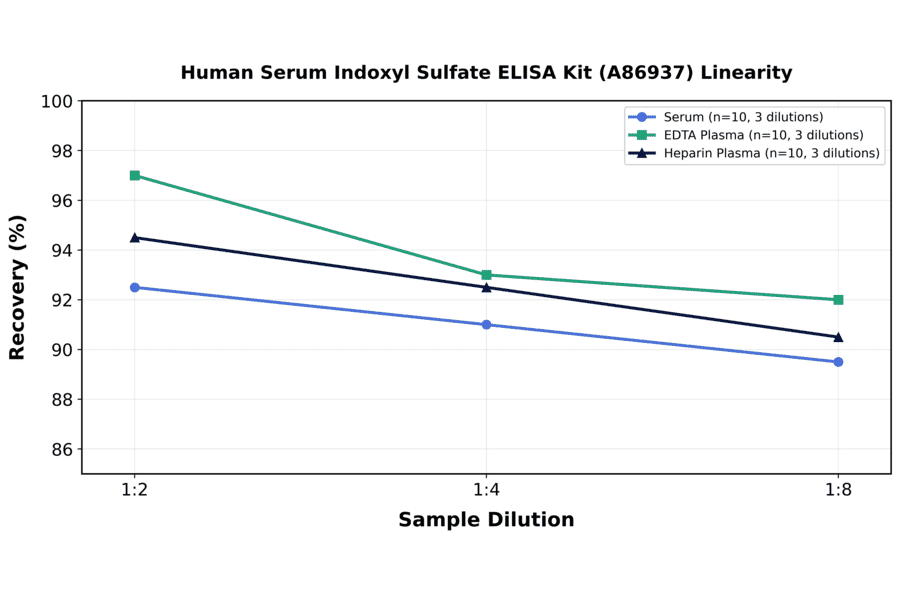

| Sample Type | n | Range | Average |
|---|---|---|---|
| Serum | 10 | 87% - 97% | 92% |
| EDTA Plasma | 10 | 87% - 102% | 96% |
| Heparin Plasma | 10 | 89% - 96% | 93% |
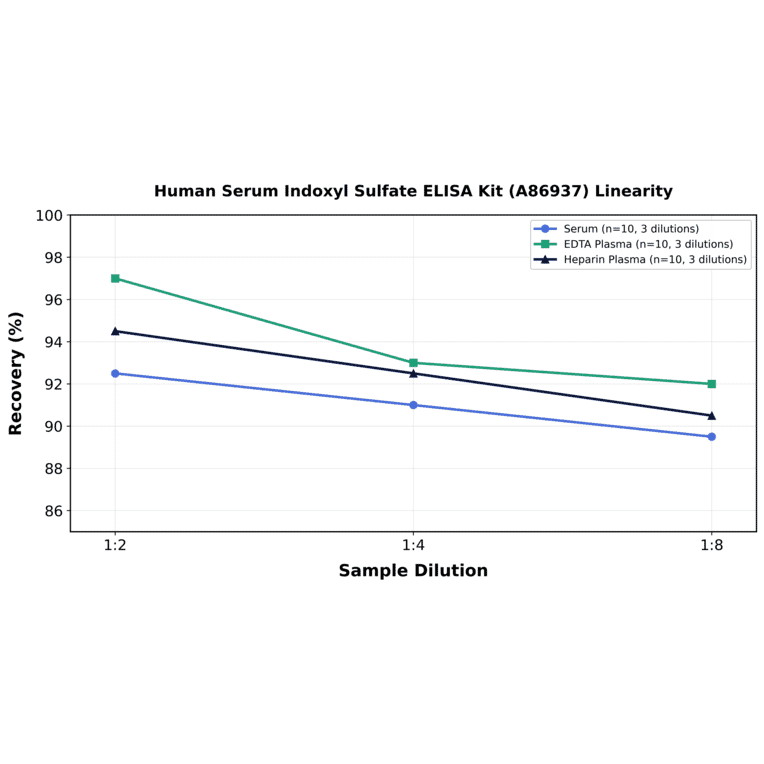
| Sample Type | n | 1:2 | 1:4 | 1:8 |
|---|---|---|---|---|
| Serum | 10 | 89-96% | 82-100% | 83-96% |
| EDTA Plasma | 10 | 90-104% | 86-100% | 84-100% |
| Heparin Plasma | 10 | 91-98% | 84-101% | 82-99% |
| Item | Quantity | Storage |
|---|---|---|
| Pre-Coated 96 Well Microplate | 12 x 8 Well Strips | +4°C |
| Lyopholized Standard | 2 Vials | +4°C |
| Sample Dilution Buffer | 20ml | +4°C |
| Biotinylated Detection Antibody | 60µl | +4°C |
| Antibody Dilution Buffer | 10ml | +4°C |
| HRP-Streptavidin Conjugate | 120µl | +4°C |
| SABC Dilution Buffer | 10ml | +4°C |
| TMB Substrate | 10ml | +4°C |
| Stop Solution | 10ml | +4°C |
| Wash Buffer (25X) | 30ml | +4°C |
| Plate Sealers | 5 Adhesive Strips | - |
| Foil Pouch | 1 Zip-Sealed Pouch | - |
Rationale & objective: Protein-bound uremic toxins, including indoxyl sulfate and p-cresyl sulfate, are poorly removed by conventional dialysis and contribute to cardiovascular, inflammatory, and neurological complications in end-stage kidney disease. Although postfilter hemodiafiltration enhances middle molecule clearance, its availability is limited. We evaluated whether combining medium cut-off dialysis with HA130 hemoadsorption achieves protein-bound uremic toxin removal comparable with that of optimized postfilter hemodiafiltration.
Study design: Prospective, single-center, parallel-group, single-session comparative study.
Setting & participants: Twenty anuric adult patients undergoing maintenance hemodialysis treated at a tertiary dialysis center were allocated to medium cut-off dialysis with hemoadsorption (n = 10) or postfilter hemodiafiltration (n = 10).
Exposure: Expanded hemodialysis using a medium cut-off membrane combined with HA130 hemoadsorption versus postfilter hemodiafiltration.
Outcomes: Corrected reduction ratios of protein-bound uremic toxins (indoxyl sulfate, p-cresyl sulfate, carboxymethyllysine, and protein carbonyls) and middle molecules (ß2-microglobulin, free light chains, prolactin, parathyroid hormone, soluble receptor for advanced glycation end-products).
Analytical approach: Predialysis and postdialysis plasma concentrations were measured, and corrected reduction ratios were calculated after adjusting for hemoconcentration. Between-group comparisons were performed using nonparametric tests.
Results: Corrected reduction ratios for key protein-bound uremic toxins were similar between medium cut-off dialysis with hemoadsorption and hemodiafiltration. Indoxyl sulfate corrected reduction ratios were 28.0% (IQR, 21.6-41.7) with medium cut-off dialysis with hemoadsorption and 26.0% (IQR, 22.5-37.9) with hemodiafiltration, while p-cresyl sulfate corrected reduction ratios were 31.8% (IQR, 23.9-37.4) versus 36.5% (IQR, 23.9-39.7), respectively (all P > 0.05). Carboxymethyllysine and protein carbonyl removal did not differ between modalities. In contrast, hemodiafiltration achieved higher corrected reduction ratios for conventional middle molecules, including ß2-microglobulin and free light chains. Reduction of soluble receptor for advanced glycation end-products was modest and comparable across treatments.
Limitations: Small sample size, single-session design, and reliance on plasma reduction ratios without direct dialysate mass measurements.
Conclusions: In this exploratory study, medium cut-off dialysis with hemoadsorption achieved protein-bound uremic toxin removal similar to that of optimized postfilter hemodiafiltration, despite lower clearance of conventional middle molecules. Hybrid strategies integrating diffusion, convection, and adsorption may expand protein-bound uremic toxin removal options, particularly where hemodiafiltration is not feasible.