
| Sample Type | n | Range | Average |
|---|---|---|---|
| Serum | 5 | 80% - 102% | 91% |
| EDTA Plasma | 5 | 81% - 100% | 90% |
| Heparin Plasma | 5 | 80% - 89% | 84% |
| Sample Type | 1:2 | 1:4 | 1:8 | 1:16 |
|---|---|---|---|---|
| Serum (n=5) | 87-91% | 87-107% | 74-101% | 92-97% |
| EDTA Plasma (n=5) | 90-105% | 84-101% | 90-101% | 79-108% |
| Heparin Plasma (n=5) | 84-95% | 92-105% | 82-105% | 89-91% |
| Item | Quantity | Storage |
|---|---|---|
| Pre-Coated 96 Well Microplate | 12 x 8 Well Strips | -20°C |
| Lyopholized Standard | 2 Vials | -20°C |
| Detection Solution A | 120μl | -20°C |
| Detection Solution B | 120µl | -20°C |
| Wash Buffer (30X) | 20ml | +4°C |
| Sample Dilution Buffer | 45ml | -20°C |
| TMB Substrate | 9ml | +4°C |
| Stop Solution | 6ml | +4°C |
| Plate Sealers | 5 Adhesive Strips | - |
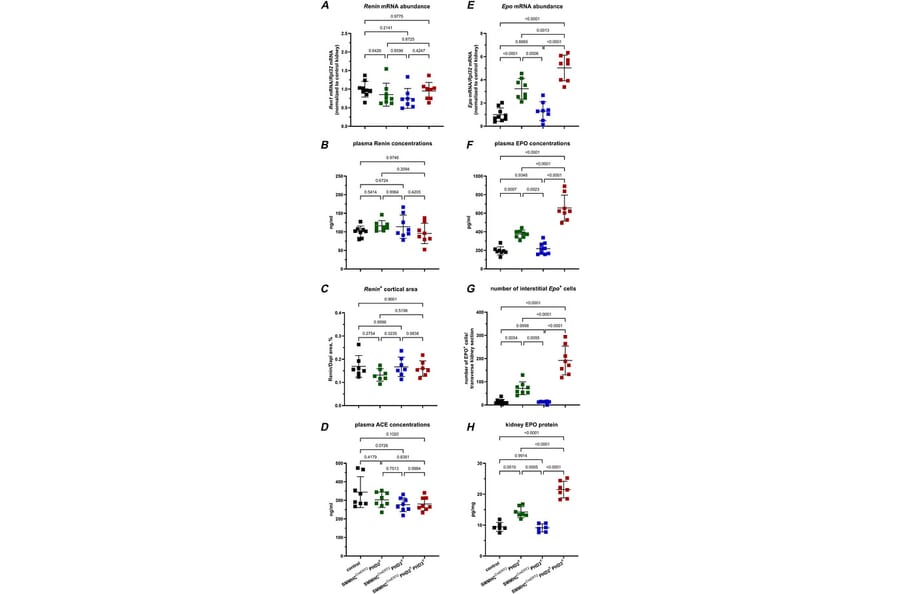
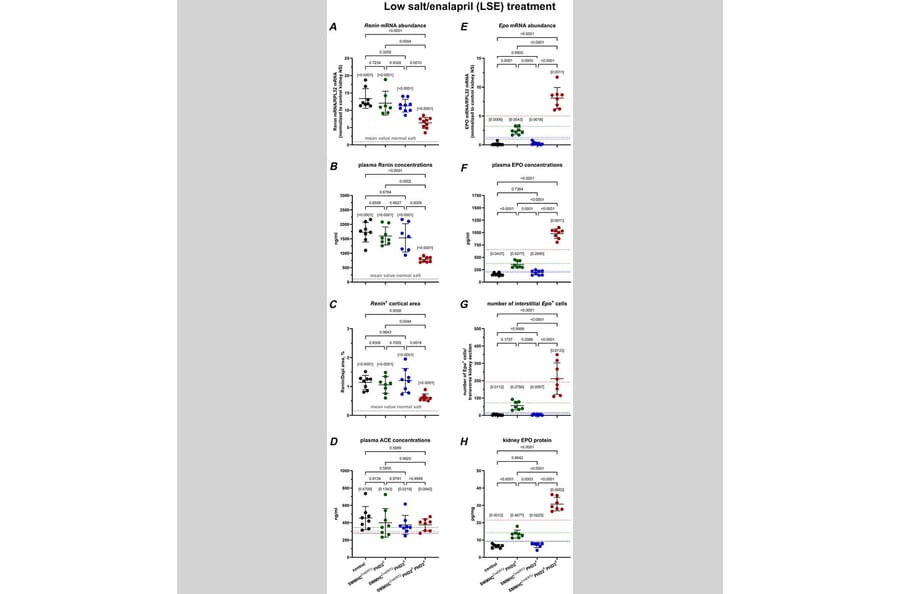
Renal juxtaglomerular renin-producing cells and preglomerular vascular smooth muscle cells (VSMCs) are specialized pericytes with notable plasticity. Preglomerular VSMCs can convert to renin-producing cells during severe hypotension or salt depletion, and renin cells can transform into erythropoietin (EPO)-producing cells when hypoxia-inducible factor (HIF)-2a is stabilized through deletion of prolyl-4-hydroxylases (PHD) 2 and 3. These findings raise the question of whether PHD2 and PHD3 likewise regulate the endocrine plasticity of preglomerular VSMCs. To investigate the role of PHD2 and/or PHD3 in (preglomerular) contractile pericytes, inducible mouse models with smooth muscle myosin heavy chain (SMMHC)-specific deletion of PHD2 and/or PHD3 were examined under basal conditions or after stimulation of renin production by treating the mice with a low-salt diet and angiotensin converting enzyme inhibitor enalapril (LSE). At baseline, none of the deletions altered renin production or induced EPO expression in preglomerular pericyte-like VSMCs, despite HIF-2a stabilization in PHD2/PHD3-deficient mice. However, HIF-2a stabilization resulting from PHD2 or PHD2/PHD3 deletion triggered EPO production in interstitial SMMHC+ contractile pericytes. LSE treatment induced renin in VSMCs and extraglomerular mesangial cells of control, SMMHCCreERT2 PHD2ff and SMMHCCreERT2 PHD3ff mice. In contrast, VSMCs of PHD2/PHD3-deficient mice produced EPO rather than renin, while renin induction persisted only in mesangial cells. Notably, this LSE-induced EPO production was reversible despite ongoing HIF-2a stabilization. Transcriptional changes indicated a shift in PHD2/PHD3-deficient VSMCs from a contractile/renin cell-like to a contractile/EPO cell-like signature. These findings indicate that HIF-2a stabilization determines the endocrine product of preglomerular VSMCs and interstitial pericytes. Notably, loss of PHD2/PHD3 does not compromise the plasticity of VSMCs to reversibly adopt endocrine functions. KEY POINTS: Smooth muscle myosin heavy chain (SMMHC)-specific deletion of the prolyl-4-hydroxylases PHD2 and PHD3 stabilized hypoxia-inducible factor (HIF)-2a in preglomerular pericyte-like vascular smooth muscle cells (VSMCs), prompting a transcriptional shift from a contractile/renin cell-like toward a more contractile/EPO cell-like signature without activating erythropoietin (EPO) transcription. A reduction in systolic blood pressure through treatment with low-salt diet and angiotensin converting enzyme inhibitor enalapril induced EPO synthesis instead of renin in preglomerular PHD2/PHD3-deficient VSMCs. Transformation of preglomerular VSMCs into EPO-producing cells was reversible despite persistent HIF-2a stabilization. SMMHC cell-specific deletion of PHD2 and PHD2/PHD3 activated EPO production in interstitial contractile pericytes independent of systolic blood pressure. Short-term HIF-2a stabilization was insufficient to induce EPO production in preglomerular VSMCs or contractile pericytes. ?aken together these findings demonstrate that HIF-2a stabilization governs the endocrine output of preglomerular VSMCs and interstitial pericytes. Notably, the loss of PHD2/PHD3 does not impair the capacity of VSMCs to reversibly assume endocrine functions.