Description
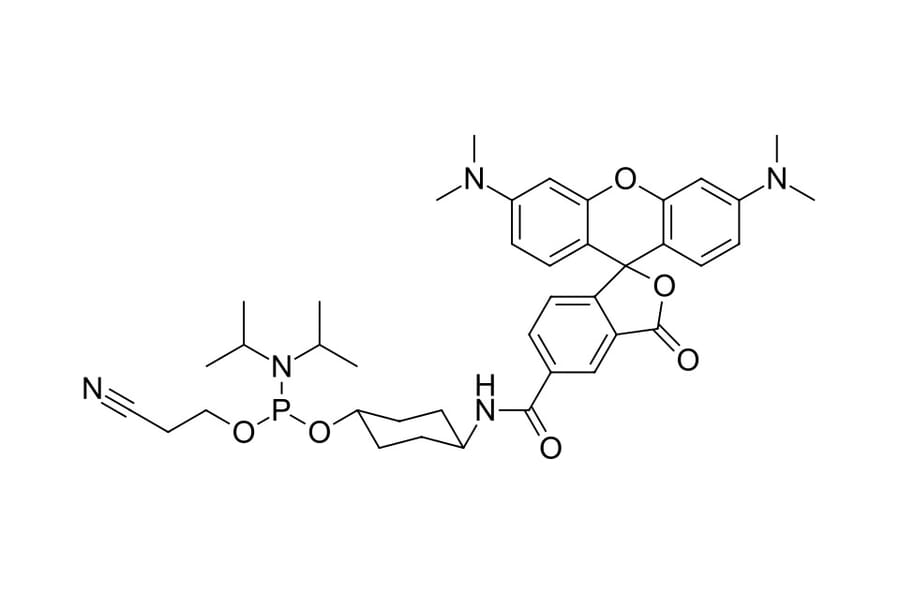
This phosphoramidite is used for synthesis of oligonucleotides 5'-labeled with TAMRA. TAMRA (carboxytetramethylrhodamine) is a xanthene dye from the rhodamine family with emission in the orange spectrum range (maximum at 563 nm). This fluorophore is traditionally used as a FRET-acceptor (and a quencher) in a pair with fluorescein (FAM) due to significant overlapping of their spectra. Thus, this phosphoramidite is convenient for the synthesis of dual-labeled probes TaqMan, which contain 5'-terminal TAMRA and FAM in the middle of the sequence or at the 3'-end (using Fluorescein dT Phosphoramidite and FAM CPG, respectively). TAMRA 5'-labeled oligonucleotides are commonly used for quantitative PCR and fragment analysis (for example, for microsatellite marker analysis) because the equipment available has a detection channel for TAMRA frequently. The TAMRA dye is not stable in the presence of ammonium and sterically non-hindered primary amines, so it is strongly recommended to follow specified conditions for labeled oligonucleotide deprotection. Coupling takes only 7.5 minutes. Deprotection should be performed with tret-buthylamine : methanol : water at a ratio of 1 : 1 : 3 (v/v/v) ("TAMRA cocktail") for 6 hours at 60 °C, then cooled down to room temperature. Due to complete and irreversible degradation of the TAMRA dye, do NOT use aqueous ammonium and AMA for deprotecting a modified oligonucleotide from the solid-phase support.