| Sample Type | n | Range | Average |
|---|---|---|---|
| Serum | 10 | 86% - 98% | 96% |
| EDTA Plasma | 10 | 88% - 105% | 96% |
| Heparin Plasma | 10 | 90% - 104% | 92% |
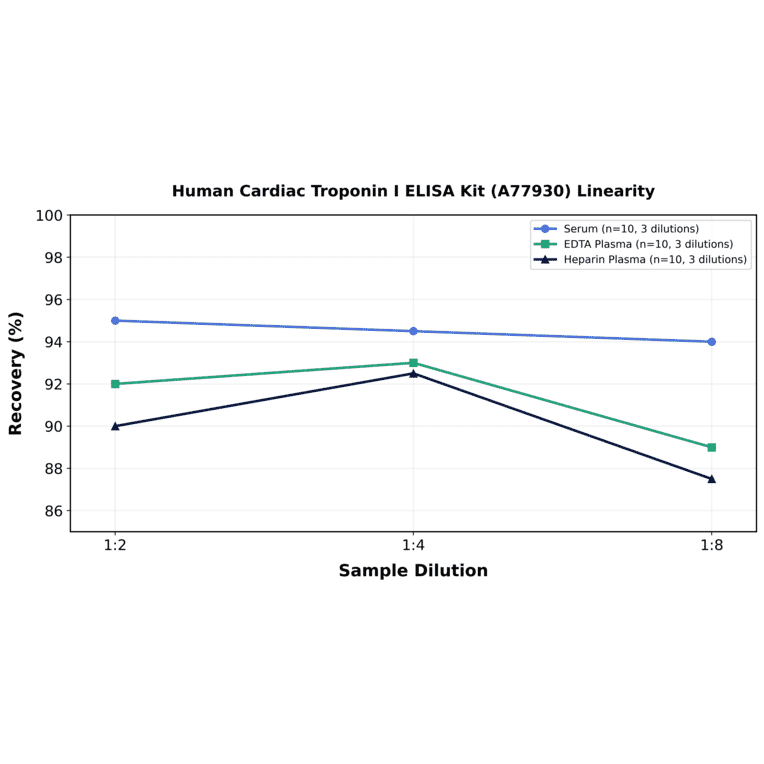
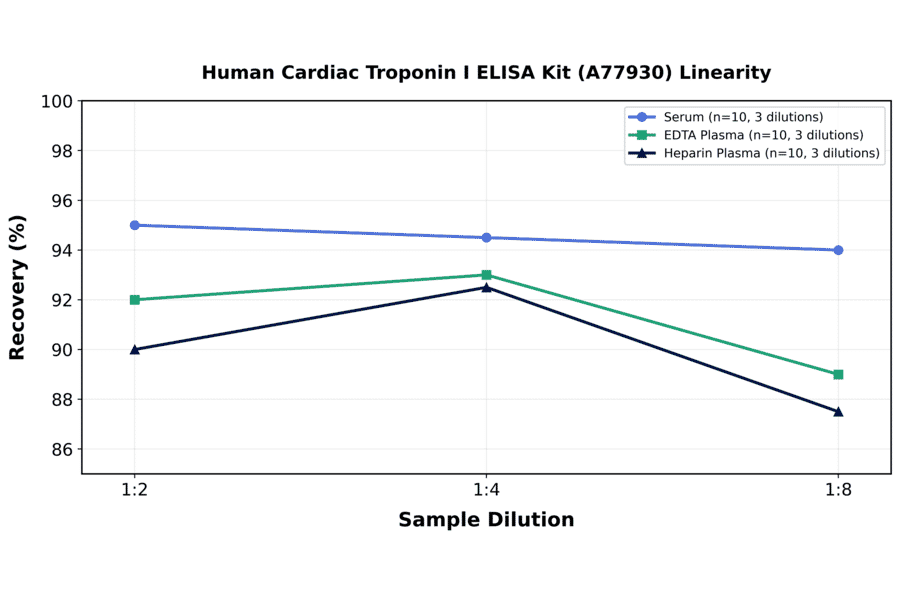
| Sample Type | n | 1:2 | 1:4 | 1:8 |
|---|---|---|---|---|
| Serum | 10 | 88-102% | 85-104% | 86-102% |
| EDTA Plasma | 10 | 86-98% | 85-101% | 82-96% |
| Heparin Plasma | 10 | 83-97% | 85-100% | 80-95% |
| Item | Quantity | Storage |
|---|---|---|
| Pre-Coated 96 Well Microplate | 12 x 8 Well Strips | +4°C |
| Lyopholized Standard | 2 Vials | +4°C |
| Sample Dilution Buffer | 20ml | +4°C |
| Biotinylated Detection Antibody | 120µl | +4°C |
| Antibody Dilution Buffer | 10ml | +4°C |
| HRP-Streptavidin Conjugate | 120µl | +4°C |
| SABC Dilution Buffer | 10ml | +4°C |
| TMB Substrate | 10ml | +4°C |
| Stop Solution | 10ml | +4°C |
| Wash Buffer (25X) | 30ml | +4°C |
| Plate Sealers | 5 Adhesive Strips | - |
| Foil Pouch | 1 Zip-Sealed Pouch | - |
This study presents the first detection of cardiac troponin I (cTnI), a vital biomarker for acute coronary syndrome diagnosis (ACS), in human interstitial fluid (ISF) collected via electroporation. Measurements were performed using molecularly imprinted polymer nanoparticles as synthetic recognition elements and a heat-transfer method within a microfluidic system, yielding results within 15-20 min. This approach demonstrated reliable cTnI quantification across a wide, physiologically relevant concentration range of 0.1 to 1000 pg mL-1 in spiked ISF, achieving an excellent detection limit of 1.85 ± 0.32 pg mL-1. Comparisons with conventional patient sample fluids were conducted by repeating experiments with cTnI-spiked plasma and serum, which exhibited similar detection limits of 1.78 ± 0.28 and 1.80 ± 0.22 pg mL-1, respectively. The developed sensor offers a rapid, highly sensitive, non-invasive, and cost-effective platform for point-of-care ACS diagnosis in ISF, potentially improving patient outcomes and easing healthcare burdens.
Cardiac troponin I (cTnI) is a critical protein biomarker for heart attack diagnosis. This study presents a thorough analysis of a novel biosensing device utilizing molecularly imprinted polymer nanoparticles (nanoMIPs) for detecting cTnI in clinical patient serum samples post myocardial infarction. The methodology, based on the heat-transfer method approach, offers faster measurements times than the current gold standard and sample volumes equivalent to a single blood drop. Biomarker binding shows performance comparable to a high-sensitivity ELISA, accurately identifying patients with elevated cTnI levels (R2 = 0.893). The cTnI peak concentration time variations are attributed to heterogeneous serum complexes, with different troponin complex sizes potentially generating differing thermal insulation levels. Comparison with an established patient database demonstrates robust correlations between our cTnI concentrations and clinical parameters (R2 = 0.855). This underscores the potential of nanoMIP sensors for sensitive cTnI detection, providing insights into post-heart attack biomarker levels. Furthermore, our methodology presents the additional benefits of being low cost and portable enabling measurements at time and place of patients. Consequently, it holds the potential to become a vital part of the diagnostic pathway for heart attack treatment, ultimately reducing healthcare costs and improving patient outcomes.