TIMs are type I transmembrane glycoproteins with one Ig-like V-type domain and a Ser/Thr-rich mucin stalk. TIM-3 is expressed on the surface of effector T cel tonsil, lymph node or spleen. ls (CD4+Th1 and CD8+Tc1) but not on helper T cells (CD4+Th2 and CD8+Tc2). In chronic inflammation, autoimmune disorders, and some cancers, TIM-3 is upregulated on several other hematopoietic cell types. The Ig domain of TIM-3 interacts with a ligand on resting but not activated Th1 and Th2 cells. The glycosylated Ig domain of TIM-3 binds cell-associated galectin-9. This induces TIM-3 Tyr phosphorylation and pro-apoptotic signaling. TIM-3 functions as a negative regulator of Th1 cell activity. Its blockade results in increased IFN-gamma production, Th1 cell proliferation and cytotoxicity, regulatory T cell development, and increases in macrophage and neutrophil infiltration into sites of inflammation.
Applications
WB, IHC-P
Dilutions
WB: 1-2 µg/ml, IHC-P: 1-2 µg/ml
Reactivity
Human
Immunogen
Recombinant fragment, around amino acids 22-202, of human TIM3 protein. The exact sequence is proprietary.
Host
Mouse
Clonality
Monoclonal
Clone ID
TIM3/4024
Isotype
IgG2b
Light Chains
kappa
Conjugate
Unconjugated
Purification
Protein A/G chromatography.
Concentration
200 µg/ml
Molecular Weight
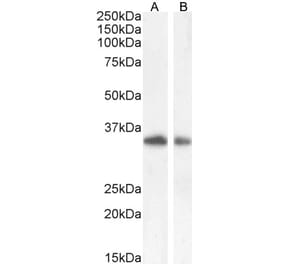
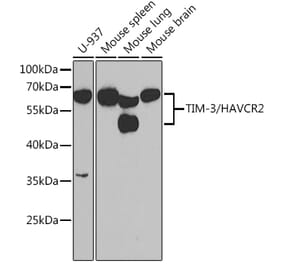
60 kDa
Product Form
Liquid
Formulation
Supplied in 10mM Phosphate Buffered Saline with 0.05% BSA and 0.05% Sodium Azide.
Storage
Shipped at 4°C. Upon delivery aliquot and store at -20°C. Avoid freeze / thaw cycles.


![Western Blot - Anti-TIM3 Antibody [TIM3/4024] (A277833) - Antibodies.com](https://cdn.antibodies.com/image/catalog/277/A277833_1.jpg?profile=product_top)
![Immunohistochemistry - Anti-TIM3 Antibody [TIM3/4024] (A277833) - Antibodies.com](https://cdn.antibodies.com/image/catalog/277/A277833_2.jpg?profile=product_top)
![Immunohistochemistry - Anti-TIM3 Antibody [TIM3/4024] (A277833) - Antibodies.com](https://cdn.antibodies.com/image/catalog/277/A277833_3.jpg?profile=product_top)
![Immunohistochemistry - Anti-TIM3 Antibody [TIM3/4024] (A277833) - Antibodies.com](https://cdn.antibodies.com/image/catalog/277/A277833_4.jpg?profile=product_top)
![Western Blot - Anti-TIM3 Antibody [TIM3/4024] (A277833) - Antibodies.com](https://cdn.antibodies.com/image/catalog/277/A277833_1.jpg?profile=product_top_thumb)
![Immunohistochemistry - Anti-TIM3 Antibody [TIM3/4024] (A277833) - Antibodies.com](https://cdn.antibodies.com/image/catalog/277/A277833_2.jpg?profile=product_top_thumb)
![Immunohistochemistry - Anti-TIM3 Antibody [TIM3/4024] (A277833) - Antibodies.com](https://cdn.antibodies.com/image/catalog/277/A277833_3.jpg?profile=product_top_thumb)
![Immunohistochemistry - Anti-TIM3 Antibody [TIM3/4024] (A277833) - Antibodies.com](https://cdn.antibodies.com/image/catalog/277/A277833_4.jpg?profile=product_top_thumb)
![Western Blot - Anti-TIM3 Antibody [TIM3/4024] (A277833) - Antibodies.com](https://cdn.antibodies.com/image/catalog/277/A277833_1.jpg?profile=product_image)
![Immunohistochemistry - Anti-TIM3 Antibody [TIM3/4024] (A277833) - Antibodies.com](https://cdn.antibodies.com/image/catalog/277/A277833_2.jpg?profile=product_image)
![Immunohistochemistry - Anti-TIM3 Antibody [TIM3/4024] (A277833) - Antibodies.com](https://cdn.antibodies.com/image/catalog/277/A277833_3.jpg?profile=product_image)
![Immunohistochemistry - Anti-TIM3 Antibody [TIM3/4024] (A277833) - Antibodies.com](https://cdn.antibodies.com/image/catalog/277/A277833_4.jpg?profile=product_image)
![Immunohistochemistry - Anti-TIM3 Antibody [TIM3/3113] (A251418) - Antibodies.com](https://cdn.antibodies.com/image/catalog/250/A250422_1.jpg?profile=product_alternative)
![Immunohistochemistry - Anti-TIM3 Antibody [TIM3/4029] - BSA and Azide free (A250425) - Antibodies.com](https://cdn.antibodies.com/image/catalog/253/A253605_1.jpg?profile=product_alternative)
![Immunohistochemistry - Anti-TIM3 Antibody [TIM3/4028] - BSA and Azide free (A250424) - Antibodies.com](https://cdn.antibodies.com/image/catalog/253/A253604_1.jpg?profile=product_alternative)
![Immunohistochemistry - Anti-TIM3 Antibody [TIM3/4025] - BSA and Azide free (A250423) - Antibodies.com](https://cdn.antibodies.com/image/catalog/253/A253603_1.jpg?profile=product_alternative)
![Immunohistochemistry - Anti-TIM3 Antibody [TIM3/3113] - BSA and Azide free (A250422) - Antibodies.com](https://cdn.antibodies.com/image/catalog/253/A253602_1.jpg?profile=product_alternative)
![Immunohistochemistry - Anti-TIM3 Antibody [TIM3/4025] (A253577) - Antibodies.com](https://cdn.antibodies.com/image/catalog/250/A250423_1.jpg?profile=product_alternative)
![Immunohistochemistry - Anti-TIM3 Antibody [TIM3/4028] (A253603) - Antibodies.com](https://cdn.antibodies.com/image/catalog/250/A250424_1.jpg?profile=product_alternative)
![Immunohistochemistry - Anti-TIM3 Antibody [TIM3/4029] (A253604) - Antibodies.com](https://cdn.antibodies.com/image/catalog/250/A250425_1.jpg?profile=product_alternative)
![Immunohistochemistry - Anti-TIM3 Antibody [TIM3/4031] - BSA and Azide free (A250420) - Antibodies.com](https://cdn.antibodies.com/image/catalog/253/A253600_1.jpg?profile=product_alternative)