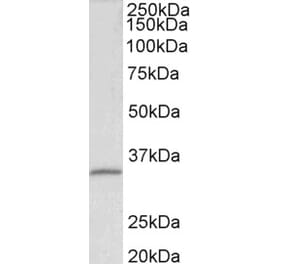

Unconjugated
Artificial biomolecular condensates have emerged as powerful tools for controlling cellular behaviour. Here we introduce a method to build artificial condensates within living mammalian cells by designing modular RNA motifs composed of a single short RNA strand. These condensates emerge spontaneously, creating RNA-rich compartments that remain separated from their surrounding environment. The RNA sequences include stem-loop domains that fold as the RNA is transcribed, and then condense in the nucleus and cytoplasm through loop-loop interactions. These sequences can be optimized and diversified, enabling the generation of distinct, non-mixing condensate populations and the programmable control of their subcellular localization. The RNA motifs can also be modified to recruit small molecules, proteins and RNA molecules in a sequence-specific manner to the RNA-rich phase. By introducing RNA linkers, we can build condensates with multiple subcompartments, whose organization can be controlled by tuning the linker stoichiometry. These artificial condensates provide a versatile platform for studying and manipulating molecular functions inside living cells.
The nucleolus serves a multifaceted role encompassing not only rRNA transcription and ribosome synthesis, but also the intricate orchestration of cell cycle regulation and the modulation of cellular senescence. G-patch domain containing 4 (GPATCH4) stands as one among the nucleolar proteins; however, its functional significances remain still unclear. In order to elucidate the functions of GPATCH4, we examined the effects of its dysfunction on cellular proliferation, alterations in nucleolar architecture, apoptotic events, and cellular senescence. Through experimentation conducted on cultured neuroblastoma SH-SY5Y cells, the reduction of GPATCH4 caused inhibition of cellular proliferation, concurrently fostering escalated apoptotic susceptibilities upon exposure to high-dose etoposide. In the realm of nucleolar morphology comparisons, a discernible decline was noted in the count of nucleoli per nucleus, concomitant with a significant expansion in the area occupied by individual nucleoli. Upon induction of senescence prompted by low-dose etoposide, GPATCH4 knockdown resulted in decreased cell viability and increased expression of senescence-associated markers, namely senescence-associated ß-galactosidase (SA-ß-GAL) and p16. Furthermore, GPATCH4 dysfunction elicited alterations in the gene expression profile of the ribosomal system. In sum, our findings showed that GPATCH4 is a pivotal nucleolar protein that regulates nucleolar morphology and is correlated with cell viability.
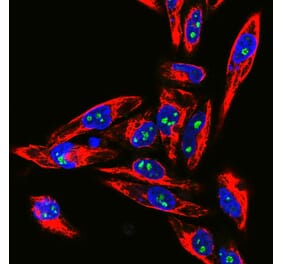
![Immunofluorescence - Anti-Fibrillarin Antibody [38F3] (A85370) - Antibodies.com](https://cdn.antibodies.com/image/catalog/85/A85370_1.jpg?profile=product_top)
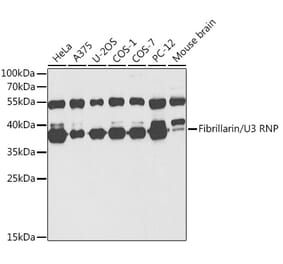
![Immunofluorescence - Anti-Fibrillarin Antibody [38F3] (A85370) - Antibodies.com](https://cdn.antibodies.com/image/catalog/85/A85370_2.jpg?profile=product_top)
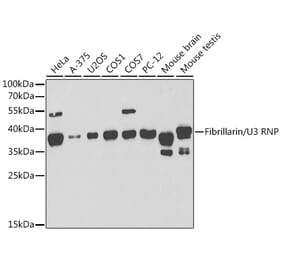
![Western Blot - Anti-Fibrillarin Antibody [38F3] (A85370) - Antibodies.com](https://cdn.antibodies.com/image/catalog/85/A85370_3.jpg?profile=product_top)
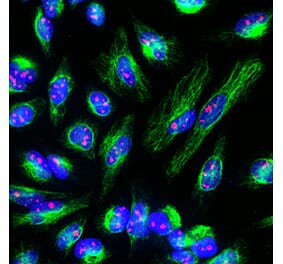
![Immunofluorescence - Anti-Fibrillarin Antibody [38F3] (A85370) - Antibodies.com](https://cdn.antibodies.com/image/catalog/85/A85370_4.jpg?profile=product_top)
![Western Blot - Anti-Fibrillarin Antibody [38F3] (A85370) - Antibodies.com](https://cdn.antibodies.com/image/catalog/85/A85370_5.jpg?profile=product_top)
![Immunofluorescence - Anti-Fibrillarin Antibody [38F3] (A85370) - Antibodies.com](https://cdn.antibodies.com/image/catalog/85/A85370_1.jpg?profile=product_top_thumb)
![Immunofluorescence - Anti-Fibrillarin Antibody [38F3] (A85370) - Antibodies.com](https://cdn.antibodies.com/image/catalog/85/A85370_2.jpg?profile=product_top_thumb)
![Western Blot - Anti-Fibrillarin Antibody [38F3] (A85370) - Antibodies.com](https://cdn.antibodies.com/image/catalog/85/A85370_3.jpg?profile=product_top_thumb)
![Immunofluorescence - Anti-Fibrillarin Antibody [38F3] (A85370) - Antibodies.com](https://cdn.antibodies.com/image/catalog/85/A85370_4.jpg?profile=product_top_thumb)
![Western Blot - Anti-Fibrillarin Antibody [38F3] (A85370) - Antibodies.com](https://cdn.antibodies.com/image/catalog/85/A85370_5.jpg?profile=product_top_thumb)
![Immunofluorescence - Anti-Fibrillarin Antibody [38F3] (A85370) - Antibodies.com](https://cdn.antibodies.com/image/catalog/85/A85370_1.jpg?profile=product_image)
![Immunofluorescence - Anti-Fibrillarin Antibody [38F3] (A85370) - Antibodies.com](https://cdn.antibodies.com/image/catalog/85/A85370_2.jpg?profile=product_image)
![Western Blot - Anti-Fibrillarin Antibody [38F3] (A85370) - Antibodies.com](https://cdn.antibodies.com/image/catalog/85/A85370_3.jpg?profile=product_image)
![Immunofluorescence - Anti-Fibrillarin Antibody [38F3] (A85370) - Antibodies.com](https://cdn.antibodies.com/image/catalog/85/A85370_4.jpg?profile=product_image)
![Western Blot - Anti-Fibrillarin Antibody [38F3] (A85370) - Antibodies.com](https://cdn.antibodies.com/image/catalog/85/A85370_5.jpg?profile=product_image)

![Immunofluorescence - Anti-Fibrillarin Antibody [4A4] (A104318) - Antibodies.com](https://cdn.antibodies.com/image/catalog/104/A104318_1.jpg?profile=product_alternative)